What Is Domain Backordering, and How Does It Work?
Thousands of domain names expire every day because their owners forget to renew, lose interest in a project, or let a business close. Some of those names are exactly what someone else has been waiting for. Domain backordering is the way to put yourself first in line for a domain that is currently registered, so that if the owner lets it go, you have a chance to get it. This article explains what a backorder is, how it fits into the domain expiration lifecycle, the different kinds of backorder services, what happens when several people want the same name, and how to decide whether placing one is worth it. If the domain you want is still in active use, you may also want to read how to buy a domain name that's already taken.
What Is a Domain Backorder?
A domain backorder is a request you place with a service, asking it to try to register a specific domain on your behalf the moment that domain becomes available. You are not buying the domain from its current owner, and you are not reserving it in any official registry sense. You are hiring a service to watch the name and act quickly when it is released or put up for sale.
Two key points shape everything else:
- A backorder does not take anything away from the current owner. If they renew, the backorder simply never succeeds.
- A backorder is not a guarantee. It is a bet that the domain will expire and that your chosen service will be the one to secure it.
Where Backorders Fit in the Domain Lifecycle
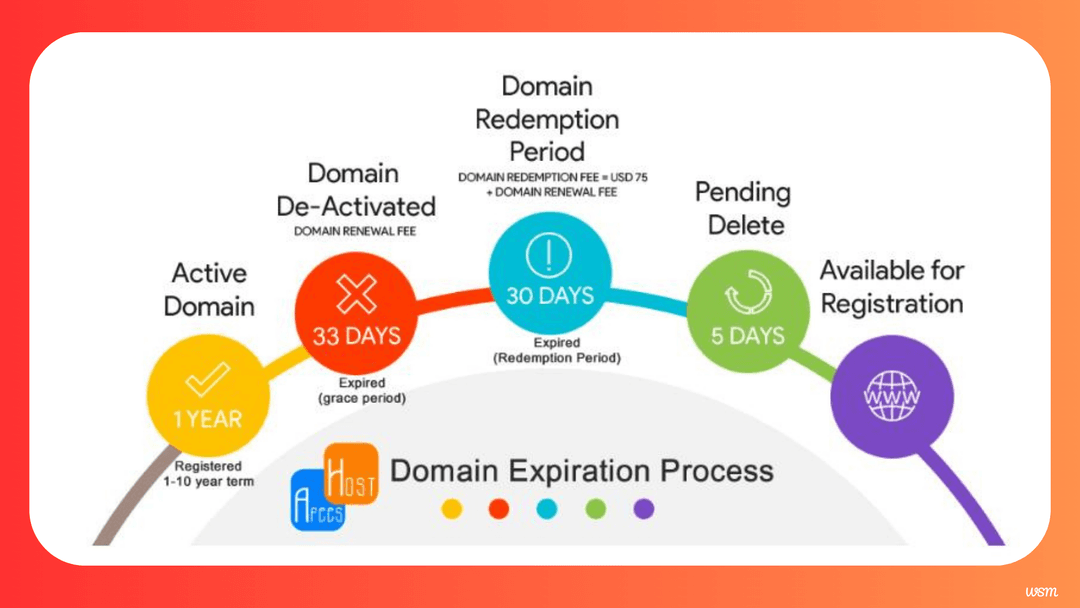
To understand backorders, you need to know what happens when a domain is not renewed. For most generic top-level domains (gTLDs) such as .com, .net, and .org, the lifecycle after the expiration date looks roughly like this:
| Phase | Typical length | What happens |
|---|---|---|
| Expiration date | Day 0 | The registration term ends. The registry usually auto-renews and bills the registrar. |
| Renewal grace period | Up to about 45 days | The original owner can still renew at the normal price. The registrar may disable the site. |
| Expired-domain auction window | Within the grace period | Many registrars offer the expired name to buyers through an auction, depending on their terms. |
| Redemption grace period (RGP) | 30 days | The domain is deleted at the registry. The owner can restore it, usually for an extra fee. |
| Pending delete | 5 days | Nothing can be done. The domain is queued for release. |
| Drop | A specific moment | The domain is removed from the registry and anyone can register it. |
The exact timing varies by registrar and registry, and country-code TLDs (ccTLDs) often follow completely different rules. For a full walk-through of these phases, see the domain grace period and redemption period and the domain expiration process.
A backorder can succeed at two different points in this lifecycle:
- Before the drop, when the owner's registrar sells the expired domain through its own auction or transfers it to an auction partner. Backorders placed with a service connected to that registrar get first access.
- At the drop, when the domain is deleted and released. Backorder services race to register it within seconds. This is called drop-catching, and it is covered in depth in our guide on how to catch an expiring domain with drop-catching services.
Types of Backorder Services
Not all backorders work the same way. They fall into three broad categories.
Registrar Backorders
Many retail registrars sell a backorder product. When you place it, the registrar monitors the domain and, if it expires, attempts to register it for you.
- Strengths: Simple, often inexpensive, and if the domain happens to be registered at that same registrar, you may get access when it expires before it ever drops.
- Weaknesses: If the domain is at a different registrar, your registrar is competing at the drop like everyone else, and a retail registrar may not have the infrastructure to win against specialist drop-catchers.
Drop-Catching Services
Specialist drop-catch services operate large networks of accredited registrar connections and submit registration requests at the moment a domain is deleted. Several of them also have agreements with retail registrars to receive expired domains before deletion.
- Strengths: The best chance of securing a domain that actually drops, especially desirable ones.
- Weaknesses: If more than one customer backorders the same domain, the service usually runs a private auction among them, so the price can rise far above the backorder fee.
Registry-Level Programs
Some registries run their own programs for expiring or released names, such as auctions or reservation systems for specific extensions. These vary widely by TLD, so check the rules of the registry you are interested in. A few ccTLDs also release domains on a known schedule, which changes the strategy entirely.
| Service type | Best for | Typical pricing model | Competition risk |
|---|---|---|---|
| Registrar backorder | Low-competition names, casual buyers | Upfront fee, sometimes refundable credit | Loses to specialists |
| Drop-catch service | Valuable or contested names | Pay only on success, then auction if contested | High for good names |
| Registry program | Specific TLDs with official release systems | Set by the registry | Depends on the TLD |
What Happens When Multiple People Backorder the Same Domain?
This is the part that surprises many first-time users. If you and others backorder the same name with the same drop-catch service, and that service catches it, you do not each get a copy, and the first person to order does not automatically win. Instead, the service typically:
- Registers the domain into its own account.
- Notifies everyone who placed a backorder.
- Opens a private auction, often with a starting price equal to the backorder fee.
- Delivers the domain to the highest bidder, usually by moving it into the winner's account at that service's registrar.
Backorders placed with different services compete only at the drop. Whichever service registers the domain first gets it, and the others fail. This is why serious buyers sometimes place backorders with more than one service. Be careful, though: some services charge on success even if you would have preferred another service to win, so read the terms before you spread orders across providers.
How Much Does a Backorder Cost?
Pricing varies a great deal between services and changes over time, so treat any figure as a rough guide. Common models include:
- Pay on success: You pay nothing unless the service secures the domain. This is common among drop-catch specialists.
- Upfront fee: You pay when you place the order. Some registrars refund the fee or convert it to account credit if the backorder fails, while others do not.
- Auction premium: If several people want the name, the final price is whatever the auction reaches.
Typical backorder fees range from the price of a normal registration up to several times that amount. The fee usually includes a year of registration. Always check what happens to your money if the original owner renews.
How to Place a Backorder
The process is broadly the same everywhere:
- Check the domain's status. Confirm it is actually registered and see when it expires.
- Choose a service based on how contested you expect the name to be.
- Place the order and confirm the payment terms and refund policy.
- Monitor the domain so you know which phase it is in.
- Respond quickly if you are invited to an auction. Auctions often run on short timelines.
- Secure the domain once it is in your account: enable registrar lock, turn on auto-renewal, and set up two-factor authentication.
Checking Status and Expiry Before You Order
You can check the current status and expiration date with RDAP:
curl -sL https://rdap.org/domain/example.com \
  | jq -r '"Status: " + (.status | join(", ")),
           (.events[] | select(.eventAction=="expiration") | "Expires: " + .eventDate)'
The status tells you a lot about your odds:
| RDAP status | What it means for a backorder |
|---|---|
active or lock statuses only | Registered normally. The owner may well renew. |
auto renew period | Expired and auto-renewed at the registry. The owner can still renew or it may be sold. |
redemption period | Deleted but restorable by the owner. Drop is likely in about five weeks if not restored. |
pending delete | Will drop within days. Backorders placed now are racing at the drop. |
If you want to track several names you are interested in, this short Python script prints each domain's status and expiry date using only the standard library:
import json
import urllib.request

WATCHLIST = ["example.com", "example.net", "example.org"]

def rdap(domain):
    req = urllib.request.Request(
        f"https://rdap.org/domain/{domain}",
        headers={"Accept": "application/rdap+json"},
    )
    with urllib.request.urlopen(req, timeout=15) as resp:
        return json.load(resp)

for domain in WATCHLIST:
    try:
        data = rdap(domain)
    except Exception as exc:
        print(f"{domain:30} lookup failed: {exc}")
        continue
    expiry = next(
        (e["eventDate"] for e in data.get("events", []) if e.get("eventAction") == "expiration"),
        "unknown",
    )
    status = ", ".join(data.get("status", []))
    print(f"{domain:30} expires {expiry:25} status: {status}")
If a lookup fails with an HTTP 404, the domain is probably not registered at all, in which case you can simply register it yourself without a backorder. For timing-critical monitoring and alerting around the drop itself, the drop-catching guide linked above goes further.
When Is a Backorder Worth It?
Backorders are a low-cost option with a wide range of outcomes. They make the most sense when:
- The owner is unresponsive and you have no realistic way to buy the domain directly.
- The domain is near expiry, or already in the grace or redemption phase.
- The website is dead, with no sign of an active business behind the name.
- You can afford to wait, possibly for several years if the owner keeps renewing.
They make less sense when the domain is clearly in active use, when the owner has renewed it for many years ahead, or when the name is so valuable that any drop will lead to an expensive auction anyway. In those cases, a direct offer or a broker may be the better route. Before you commit, it also helps to estimate what the name is worth using the methods in how to value a domain name.
Risks and Things to Check
- Domain history: An expired domain may carry baggage, such as spam, malware, or penalties. Check the history before you bid. See how to check a domain's history.
- Trademarks: Catching a domain that matches someone else's trademark can expose you to a dispute. Expired status does not cancel trademark rights.
- Restoration: In rare cases, an original owner may contest a sale of an expired domain. Reputable services have terms covering this, so read them.
- Auction fever: Set a maximum before the auction starts and stick to it.
Domain Backordering FAQ
No. The owner may renew, another service may catch the domain first, or another customer may outbid you in a private auction. A backorder only gives you a chance at the domain if it becomes available.
Yes. Backordering is a normal, widely used service. It simply attempts to register a domain after its owner lets it expire. Trademark law still applies to whatever domain you end up registering.
Generally no. Backorders are placed with a service, not with the owner. Some services show how many backorders exist on a name, but they do not normally reveal who placed them.
Yes. Most services let you backorder any registered domain, and the order stays active until the domain drops or you cancel. Some services charge only on success, which makes long-term backorders inexpensive.
For contested names it can improve your odds, because different services compete at the drop. Read each service's terms first, since you may be charged by whichever one succeeds, and you could end up in more than one auction.
Backordering is the request you place. Drop-catching is the technical process many services use to fulfill it, sending registration requests at the moment a domain is deleted. A backorder can also be fulfilled before the drop through an expired-domain auction.
Sometimes. Many ccTLDs have their own expiry and release rules, and some do not use the gTLD grace and redemption periods. Check which extensions a service supports before ordering.
Conclusion
Domain backordering is a simple idea built on a complex process. You ask a service to watch a registered domain, and if the owner lets it lapse, that service tries to secure it, either through an expired-domain auction during the grace period or by catching it the moment it drops after redemption and pending delete. Registrar backorders are cheap and easy, specialist drop-catch services give better odds on contested names, and registry programs apply only to certain extensions.
Treat a backorder as a low-cost option, not a promise. Check the domain's status and history, understand the pricing and auction rules of the service you choose, set a maximum budget, and secure the domain properly the moment it lands in your account.
Here are some useful references for going deeper on domain backordering and expiration:
- ICANN: Expired Registration Recovery Policy — the rules registrars must follow when a gTLD domain expires.
- ICANN: gTLD Lifecycle — a diagram and explanation of the phases a gTLD domain goes through after expiry.
- RFC 3915: Domain Registry Grace Period Mapping for EPP — defines the grace, redemption, and pending delete statuses.
- ICANN: Registrant Educational Materials on Expired Domains — ICANN's guidance for registrants about renewal and expiration.