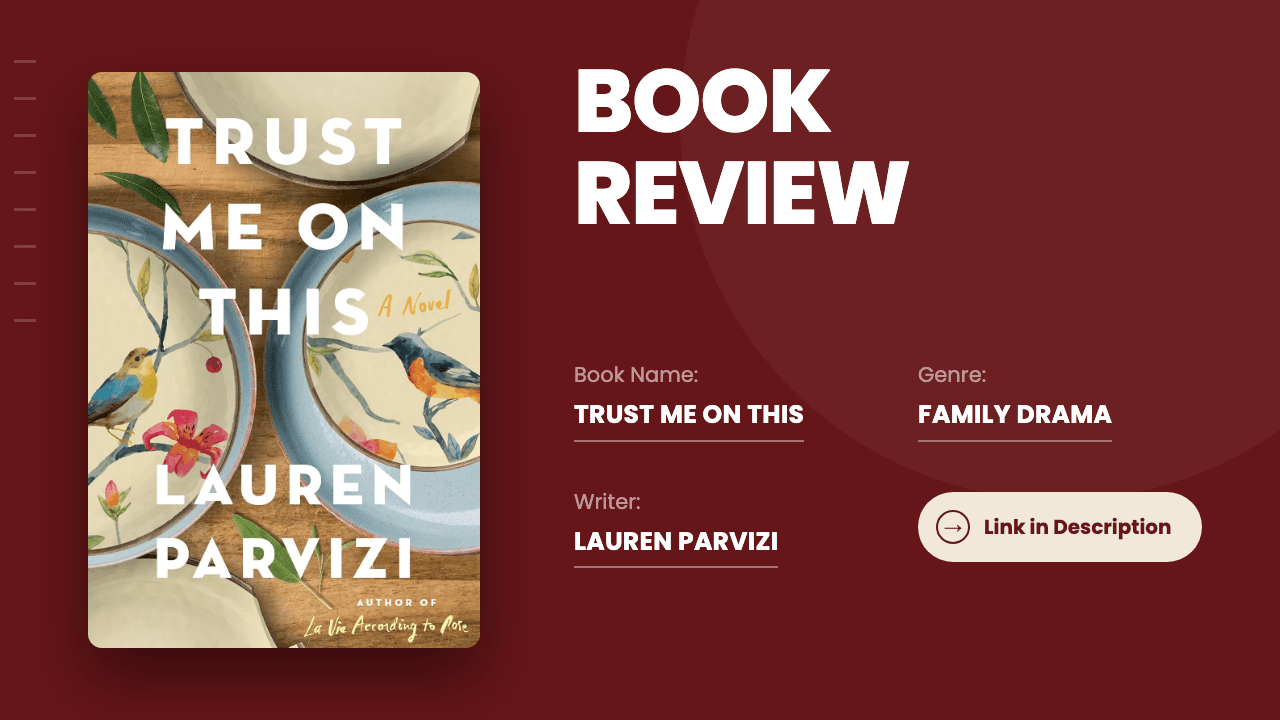
Trust Me on This Review: Two Sisters, One Car, and a Secret Their Father Won't Take With Him
- Sajjad
- Book Reviews
- 14 Sep, 2026
Put two people who barely tolerate each other in a car for eleven hundred miles and something has to give. Trust Me on This by Lauren Parvizi bets its entire novel on that pressure, half sisters Zahra Starling and Aurora sharing one vehicle up the West Coast toward a dying father who's been sitting on a secret he refuses to take with him, and the book is at its best when it trusts that forced proximity to do the work instead of reaching for melodrama to speed things along.
I went into "Trust Me on This" expecting a fairly standard sister-reconciliation road trip, two women who've drifted apart getting thrown together, bickering their way toward understanding by the final chapter. What I found was a book more interested in the specific, practical reasons Zahra and Aurora never bonded in the first place, a guarded LA chef and a bubbly rising Hollywood starlet who share a father and almost nothing else, and a road trip that reopens old wounds well before it starts closing any of them. In this review, I'll cover Zahra and Aurora's fractured relationship, the secret their father Dom has been holding onto, how the eleven-hundred-mile drive functions as the book's real engine, where Parvizi's journalism background gives the West Coast setting real texture, and where the character work doesn't always match the strength of the premise.
Overview: What Trust Me on This Is About
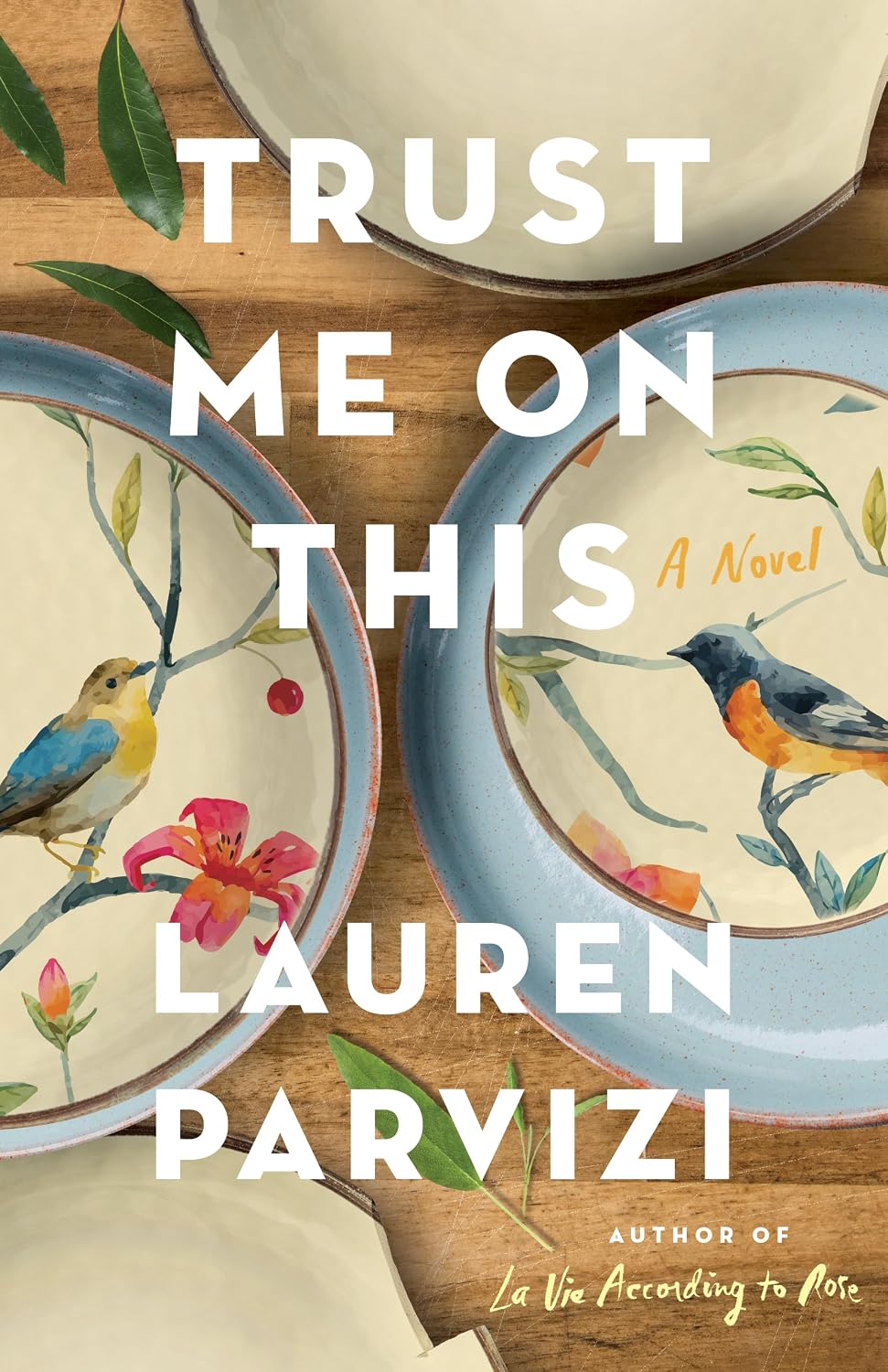
"Trust Me on This" introduces Zahra Starling and her younger half sister, Aurora, as two women who share a father and little else. Zahra, still carrying the weight of an unspecified terrible loss, has built a small, guarded life around her LA kitchen, more comfortable with solitude than with people, and especially wary of family. Aurora is her opposite in nearly every visible way, a rising Hollywood starlet with a life that looks, from the outside, like everything she's ever wanted, except for the one thing money and fame can't buy her: an actual relationship with her sister.
The plot ignites when their father, Dom, dying and running out of time, asks for both daughters at his side, along with a promise that he has something important to tell them, a secret that's been a long time coming. Zahra's history with trauma means flying isn't an option, so the two sisters end up sharing a single car for the drive to Seattle, roughly eleven hundred miles of forced proximity neither one particularly wants. For Aurora, the drive is a chance to finally win over her prickly older sister. For Zahra, it's simply the only way to get to her father before it's too late. Neither of them is prepared for how much the trip itself ends up costing, or how much it gives back.
Zahra and Aurora: Sisters Who Share Nothing But a Father
What makes the central relationship work, at least early on, is how specific Parvizi is about why these two women never connected in the first place. This isn't a case of a single misunderstanding keeping sisters apart; it's a lifetime of different childhoods, different personalities, and different ways of coping with the same complicated father, compounding into a gap that neither of them has had any real incentive to close. Zahra's instinct is to retreat into solitude and routine, Aurora's is to perform warmth and stay busy enough not to sit with anything uncomfortable, and those competing coping mechanisms make for believable friction once they're stuck together with nowhere else to go.
The road trip forces exactly the kind of extended, unstructured time that neither sister has ever given the relationship, and Parvizi uses that time well in the book's first half, letting old grievances surface in the mundane way they actually do on long drives, over gas station coffee and radio silence and the accidental honesty that comes from being bored and trapped in a car with someone. It's a smart structural choice: the plot doesn't need to manufacture confrontations because the format is already doing that work.
The Secret Dom Won't Take With Him
I'm not going to spoil what Dom's revelation actually turns out to be, partly because the book earns some of its momentum from that uncertainty and partly because most reviewers who've read it have been careful to protect it too. What I will say is that the secret functions as the trip's real destination in more than the literal sense, the thing both sisters are driving toward without fully admitting how much they're dreading finding out. Several readers who otherwise found the book emotionally thin still singled out Dom's revelation as the strongest, most earned piece of the novel, the moment where the setup's promise actually pays off. I'd agree with that read. The build toward it is more patient than flashy, and the payoff mostly justifies the patience it asks for.
One Car, Eleven Hundred Miles: The Road Trip as Forced Intimacy
The choice to strand Zahra and Aurora in a single car rather than letting them fly separately and reunite at their father's bedside is the book's smartest structural decision, because it removes the easiest way out. There's no separate hotel room to retreat to, no convenient excuse to end a hard conversation early, just miles of West Coast highway and a sister on the other side of the console who isn't going anywhere. That format does real work in the book's stronger stretches, forcing both women into honesty they'd otherwise avoid simply because there's nowhere else for the tension to go.
It also gives Parvizi room to use the drive itself as a kind of structure, mile markers and stops standing in for chapters of the sisters' slowly shifting dynamic. When the book is firing, the physical journey and the emotional one move in tandem convincingly enough that the eleven-hundred-mile setup feels earned rather than gimmicky.
Parvizi's Journalism Background Shows in the Scenery
Lauren Parvizi spent years as a travel and lifestyle editor before turning to fiction, and that background is easy to spot in how vividly the West Coast itself comes through on the page. Readers have specifically praised the "gorgeous scenery" and "incredible food" that texture the drive from LA to Seattle, and that praise tracks with what a career spent writing about place and travel would naturally sharpen. The road trip novel lives or dies on whether the journey itself feels worth taking, and Parvizi's eye for specific, sensory detail, the kind of thing a travel editor learns to notice, is what keeps the drive from feeling like empty mileage between plot points.
Where the Characters Fall Short
I want to be direct about the book's most consistent criticism, because it's a fair one: several readers, myself included at points, struggled to fully connect with Zahra and Aurora as people rather than as functions of the plot's family-drama machinery. One reviewer put it plainly, noting she "didn't feel any connection at all to either of the two main characters" despite the premise offering plenty to work with, and another described feeling lukewarm throughout, unable to find either sister especially likable even while recognizing the story had real emotional material to draw from.
That's a real weakness, and it's specifically frustrating given how promising the setup is. The road trip structure does a lot to generate tension organically, but tension needs people you're invested in to land emotionally, and Zahra and Aurora sometimes read as thinner than the situation they're in deserves, more defined by their circumstances, the chef, the starlet, the estranged sister, than by interior lives that go beyond those labels. The book's ideas about trust, forgiveness, and family are genuinely strong; the execution doesn't always give those ideas characters sturdy enough to carry them.
The Ending and Whether It Earns Its Reveal
Without spoiling specifics, the sisters' arrival in Seattle and the conversation with Dom that follows is where "Trust Me on This" cashes in everything the drive has been building toward, and for the most part, it delivers. The revelation lands with more weight than the thinner character work elsewhere might suggest it would, largely because Parvizi has been patient enough not to rush toward it. Readers who found the middle stretch emotionally flat generally still credit the ending with pulling the book back together, even if it doesn't fully erase the distance some felt from Zahra and Aurora along the way.
Critical Reception and Reader Response
"Trust Me on This" holds a strong 4.3-star average across more than 2,600 Amazon ratings, a reception that points to a book with a genuinely appreciative readership even amid some more mixed critical takes. Fans have praised its "emotional family angst and clever, sharp writing," calling it "a bingeable road trip up the West Coast with gorgeous scenery, incredible food, and indelible characters," and several readers said they were too invested to put it down once Zahra and Aurora hit the road.
The criticism tracks consistently with what I noticed: some readers felt the sisters lacked depth, with one describing an inability to connect with either main character despite the story having "families, sisters, scandals and secrets" working in its favor, and a few felt the emotional payoff didn't fully match the setup's promise. None of that stopped most reviewers from finishing the book in a hurry, and the overall sentiment leans toward a road trip novel that's genuinely moving in its best moments, even when its characters don't always earn the full weight of what they're carrying.
About Author Lauren Parvizi
Lauren Parvizi is a San Francisco Bay Area writer and editor who spent more than a decade in journalism before turning to fiction, including a stint as the online editor for SFGate's Living, Travel, and Real Estate sections and a run as a love and relationships columnist. That travel-writing background is a clear throughline in "Trust Me on This," and it shows up specifically in how confidently the book renders its West Coast settings. Her debut novel, "La Vie, According to Rose," won the 2024 Women's Fiction Writers Association STAR Award in the Debut category, and "Trust Me on This" builds on that foundation with a more structurally ambitious setup, tying its central family drama directly to the physical mechanics of a cross-state road trip.
How Trust Me on This Compares to Other Sister-Focused Family Dramas
What distinguishes this book from the broader shelf of estranged-sisters fiction is its commitment to the road trip as more than a backdrop. Plenty of family dramas send siblings on a journey together and then treat the travel itself as incidental, a device to get characters into the same room. Parvizi instead lets the mechanics of the drive, the shared car, the lack of an easy exit, the enforced hours of proximity, do real structural work, which gives "Trust Me on This" a tighter throughline than looser ensemble family dramas often manage. It's a book that understands its own format is part of its argument about what it takes to actually repair a relationship: time, proximity, and nowhere else to be.
Key Takeaways from Trust Me on This
The road trip structure is the book's smartest choice. Trapping Zahra and Aurora in one car for eleven hundred miles removes every easy exit from their unresolved history, and the tension benefits from it.
Dom's secret earns its buildup. Even readers who found other parts of the book thin still credited the father's revelation as a genuinely strong, well-paced payoff.
Parvizi's travel-writing background elevates the setting. The West Coast scenery and food detail give the drive a sensory richness that keeps the journey from feeling like filler.
The sisters could use more interior depth. Some readers struggled to connect with Zahra and Aurora as people rather than as stand-ins for the plot's family-drama beats.
It rewards patience over instant gratification. Readers wanting constant emotional fireworks may find the middle stretch slower than the premise promises, though the ending largely reconnects the threads.
Conclusion: Is Trust Me on This Worth Reading?
"Trust Me on This" takes a familiar premise, estranged sisters forced together by a parent's mortality, and sharpens it with a structural choice that actually matters: one car, one long drive, and no easy way to avoid each other. Zahra and Aurora's specific, believable reasons for never bonding give the setup real credibility, Dom's secret earns the patience it asks readers to have, and Lauren Parvizi's eye for West Coast scenery keeps the eleven-hundred-mile drive from ever feeling like padding.
It isn't a book without rough edges, the sisters themselves could have used more interior life to fully match the strength of their circumstances, and readers wanting nonstop momentum may find the middle stretch slower going. But as a road trip novel that trusts proximity and time to do its emotional heavy lifting, "Trust Me on This" mostly delivers on its premise. You can pick up a copy of "Trust Me on This" on Amazon and find out whether Zahra and Aurora make it to Seattle with anything left to say to each other.