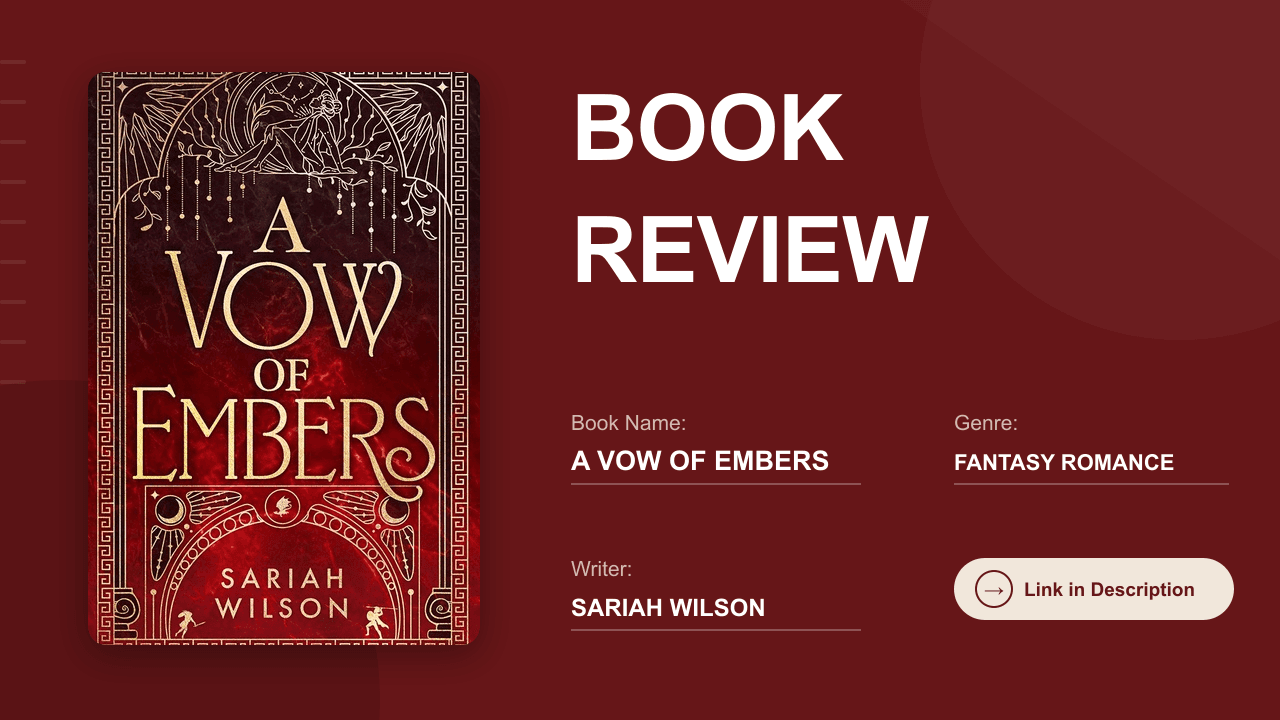
A Vow of Embers Review: A Forced Marriage That Can't Be Consummated, and 584 Pages of Consequences
- Sajjad
- Book Reviews
- 14 Sep, 2026
A romance built around a marriage that legally can't be consummated is making a specific promise to its reader: an enormous amount of tension with nowhere obvious to release it. A Vow of Embers makes good on that promise almost to a fault, stretching Lia and Prince Alexandros's forbidden, blackmailed union across 584 pages of longing, suspicion, and slowly dismantling resentment. Sariah Wilson clearly knows exactly what she's building toward, and readers who love a long, aching slow burn will find plenty to love here. Readers hoping for a faster payoff should know exactly what they're signing up for.
I came to "A Vow of Embers" as the second book in Wilson's Eye of the Goddess trilogy, picking up right where "A Tribute of Fire" left Lia and her sister Quynh. What I found was a densely plotted, mythology-rich fantasy romance that takes its central romantic obstacle, a literal magical prohibition on consummating a marriage, and uses it as the engine for nearly the entire book, for better and occasionally for worse.
In this review, I'll walk through the blackmail that forces Lia into marrying Prince Alexandros, the goddess's law that keeps their union unconsummated, the supernatural bond that develops between them anyway, and the quest for the Eye of the Goddess artifact running underneath all of it. I'll also talk honestly about the pacing, because a book this committed to sustained romantic tension is going to test some readers' patience, and it's worth knowing that going in.
Overview: What A Vow of Embers Is About
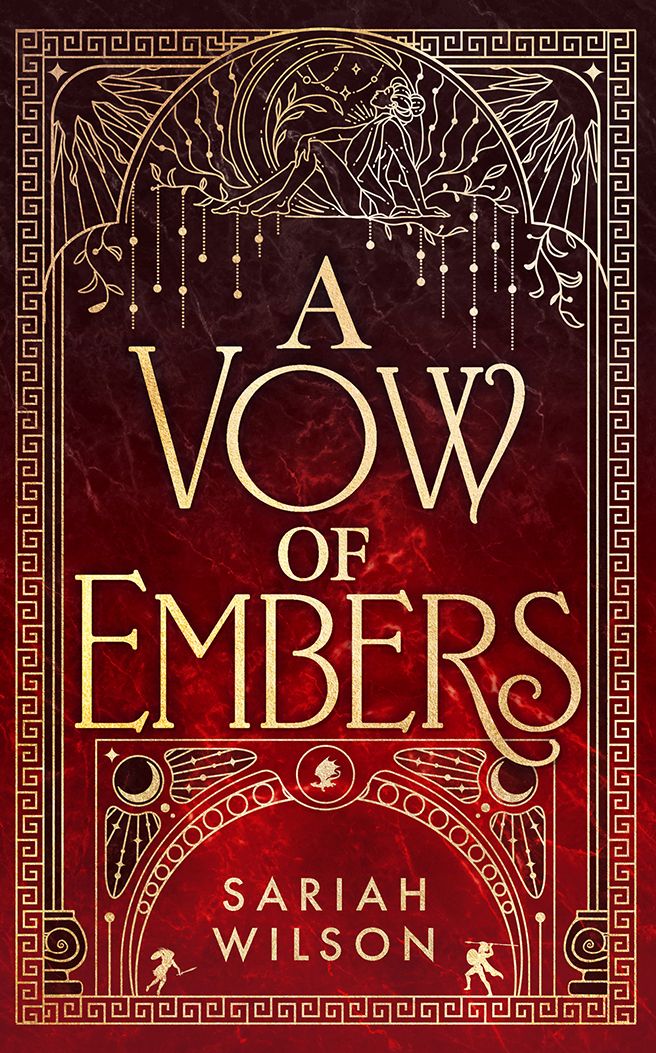
"A Vow of Embers" finds Lia, a trained warrior always ready for battle, facing a fight she can't win with a sword: Prince Alexandros is blackmailing her into marriage, holding her sister Quynh hostage to force her compliance. The union is built on betrayal and open resentment from the start, and Lia goes into it prepared to hate every second of it. There's one small mercy built into the arrangement: by the goddess's own law, the marriage cannot be consummated, a clause that initially comes as a relief to a woman being forced into a union she never wanted.
That relief doesn't last. Marriage to Alexandros gives Lia access to the palace and, with it, a genuine opportunity to investigate the Eye of the Goddess, the powerful artifact at the center of the series' larger mythology. As Lia digs into the palace's secrets and Alexandros's own motives prove more complicated than the manipulative blackmailer she initially takes him for, the two begin experiencing an inexplicable supernatural bond, walking in each other's dreams, sharing physical pain, connected in ways that neither of them asked for and neither can fully explain. Meanwhile, threats to the throne and to both their lives keep escalating around them, forcing Lia and Alexandros to figure out whether they can actually trust each other before it's too late.
Lia and Alexandros: A Bond Neither of Them Chose
The central relationship is where Wilson invests most of the book's energy, and the setup gives her real material to work with. Lia's fury at being blackmailed is entirely earned, and the book doesn't ask her to simply get over it; her resentment toward Alexandros persists genuinely, complicating any straightforward path toward romance even as the supernatural bond between them deepens. Alexandros himself is drawn as considerably more sympathetic than his introduction suggests, a man whose claimed desire for a marriage in name only, purely to secure his claim to the throne, gradually reveals itself as more complicated, and more genuinely caring, than Lia initially gives him credit for.
The shared dreams and shared pain mechanic gives the bond between them a genuinely fantastical, high-stakes texture beyond typical forced-marriage tropes; this isn't simply two people slowly warming to each other, it's two people physically and psychically tethered by forces neither of them controls, which raises the stakes of their eventual trust considerably. That's a smart use of the genre's supernatural elements to reinforce, rather than just decorate, the central romantic tension.
The Consummation Clause: A Clever Engine, Stretched Thin
The goddess's law forbidding consummation is the book's most distinctive structural choice, and it's worth being honest about both what it accomplishes and where it strains. On the positive side, it's a genuinely clever device: it removes the easiest, most conventional resolution to romantic tension and forces Wilson to build intimacy between Lia and Alexandros through every other available channel, shared vulnerability, physical danger, the psychic bond, small trust-building gestures, rather than defaulting to physical consummation as a shortcut to emotional resolution.
Where it strains is in sheer length. At 584 pages, a significant portion of the book is spent in the specific emotional space of two people who are drawn to each other but legally, magically barred from acting on it, and that space, while initially compelling, starts to feel repetitive well before the book's plot machinery catches up. One reader summarized the experience bluntly: roughly 500 pages spent on two characters deciding whether or not to act on their attraction, followed by a much shorter stretch of actual plot resolution. That's an exaggeration, but not by as much as I'd like it to be, and it's a fair account of where the pacing genuinely tests patience.
The Eye of the Goddess Quest and a Rich Mythological World
Running underneath the central romance is the larger quest to understand the Eye of the Goddess itself, and this is where Wilson's worldbuilding gets to stretch its legs. The series' mythological foundation, clearly inspired by ancient Greek religious and cultural touchstones given Lia's origins in Locris, gives the palace intrigue and artifact-hunting plot real texture, and supporting characters like Io, described consistently by readers as brilliant and loyal, add welcome depth to a story that could otherwise stay entirely contained within Lia and Alexandros's central dynamic. Subplots involving the palace's acolytes further widen the world beyond the central couple, giving the book's slower romantic stretches something else to hold onto.
The threats to the throne that escalate throughout the book give the plot real forward momentum in its second half, and the eventual convergence of the romantic, mythological, and political threads is genuinely satisfying when it finally arrives, even if it takes considerably longer to get there than a tighter edit might have allowed.
Where the Miscommunication Wears Thin
I'd be underselling this review if I didn't address the criticism that surfaces most consistently among readers: extensive miscommunication between Lia and Alexandros stretched across most of the book's considerable length. Some readers have found this narratively justified, a natural consequence of two people forced into secrecy and mutual suspicion by the terms of their own marriage, and there's a reasonable case to be made for that reading. Others have found it simply frustrating, an extended withholding of information and emotional honesty that exists more to sustain tension across nearly 600 pages than because it's the most believable choice these particular characters would make once the stakes escalate as high as they do.
I land somewhere in the middle. The miscommunication is more textually justified here than in a lot of romance novels that lean on the device lazily, given how much genuine reason both Lia and Alexandros have to distrust each other at the outset. But even a well-motivated slow burn can overstay its welcome, and this one pushes right up against that limit, if not slightly past it, before the book's back half finally lets its two leads actually talk to each other.
Sariah Wilson's Craft: Ambitious Mythology, Committed Slow Burn
None of that undercuts what Wilson does well here. Her commitment to building a richly detailed mythological world, grounded in genuine ancient Greek cultural texture rather than generic fantasy trappings, gives the series real distinctiveness within a crowded romantasy field. Her handling of the supernatural bond between Lia and Alexandros is inventive, and her willingness to let her protagonist's anger and distrust breathe rather than resolving too quickly shows real confidence in slow-burn construction, even when that construction runs longer than some readers will have patience for.
Wilson, a USA Today bestselling author of more than two dozen romantic fantasy and contemporary romance novels, clearly understands exactly what her audience wants from this kind of forced-marriage, will-they-won't-they structure, and she delivers it in full, uncompromising measure.
How A Vow of Embers Fits Into the Eye of the Goddess Trilogy
Following "A Tribute of Fire," which introduced Lia's deadly curse-breaking race to save her nation of Locris alongside her sister Quynh, "A Vow of Embers" picks up immediately where that book left off, and readers have specifically praised how well it continues directly from the first installment's ending rather than skipping ahead. As the middle book in a trilogy set to conclude with "A Curse of Ashes," "A Vow of Embers" does the expected work of deepening the central relationship and expanding the mythological stakes, even as its considerable length suggests a series more interested in slow, thorough world-building and relationship development than in tight, efficient plotting.
About Author Sariah Wilson
Sariah Wilson is a USA Today bestselling author of more than two dozen romantic fantasy and contemporary romance novels, including "A Tribute of Fire," "The Chemistry of Love," and "Roommaid." Her work in The Eye of the Goddess series shows real commitment to blending ancient mythology with the genre conventions of modern fantasy romance, and "A Vow of Embers" continues that project with a level of detail and world investment that clearly appeals to readers looking for an immersive, long-form romantasy experience.
Critical Reception and Reader Response
"A Vow of Embers" holds a strong 4.11-star average across more than 10,500 Goodreads ratings and over 1,000 written reviews, a solid reception for a lengthy trilogy middle installment. Readers have consistently praised the book as "even better than book 1," specifically highlighting how well it picks up directly from the first book's ending, and many have singled out the character and plot developments as "just wonderful," with particular enthusiasm for the mythological world-building and the complexity of the acolyte subplots.
The criticism that surfaces most consistently centers on pacing and repetition: multiple readers flagged the extensive miscommunication between Lia and Alexandros as frustrating given the book's length, with one memorably summarizing it as hundreds of pages spent on will-they-won't-they tension followed by a comparatively brief stretch of actual plot resolution. Even critical readers, however, tend to frame the miscommunication as narratively justified given the characters' circumstances rather than simply lazy plotting, suggesting the frustration is more about pacing than about the underlying character logic.
Key Takeaways from A Vow of Embers
The unconsummated marriage clause is a genuinely clever device. It forces intimacy to build through every channel except the easiest one, giving the romance real structural ambition.
Lia and Alexandros's supernatural bond raises real stakes. Shared dreams and shared pain give their connection fantastical weight beyond typical forced-marriage tropes.
The mythological world-building is a genuine strength. Ancient Greek cultural texture and characters like Io give the book depth beyond its central couple.
The pacing tests real patience. At 584 pages, the slow burn runs considerably longer than some readers will want, even when it's textually justified.
This is a direct continuation, not a fresh starting point. Readers should begin with "A Tribute of Fire" to get the full emotional payoff of this installment.
Conclusion: Is A Vow of Embers Worth Reading?
"A Vow of Embers" is an ambitious, richly mythological fantasy romance that commits fully to its central conceit, a forced marriage bound by a goddess's law against consummation, and builds nearly 600 pages of genuine tension, supernatural stakes, and slowly dismantling distrust around it. Lia and Alexandros's bond is inventive and well-earned by the time the book's plot threads converge, and Sariah Wilson's mythological world-building gives the series real distinctiveness within its genre.
It asks considerable patience of its reader, the slow burn runs long even by romantasy standards, and the extensive miscommunication between its leads will frustrate some readers more than others. But if you're drawn to a long, aching, mythologically grounded romance that takes its time earning every moment of eventual release, "A Vow of Embers" delivers exactly that, consequences and all. You can pick up a copy of "A Vow of Embers" on Amazon and see whether Lia and Alexandros's unconsummated marriage tests your patience the way it did for some readers, or rewards it the way it did for most.