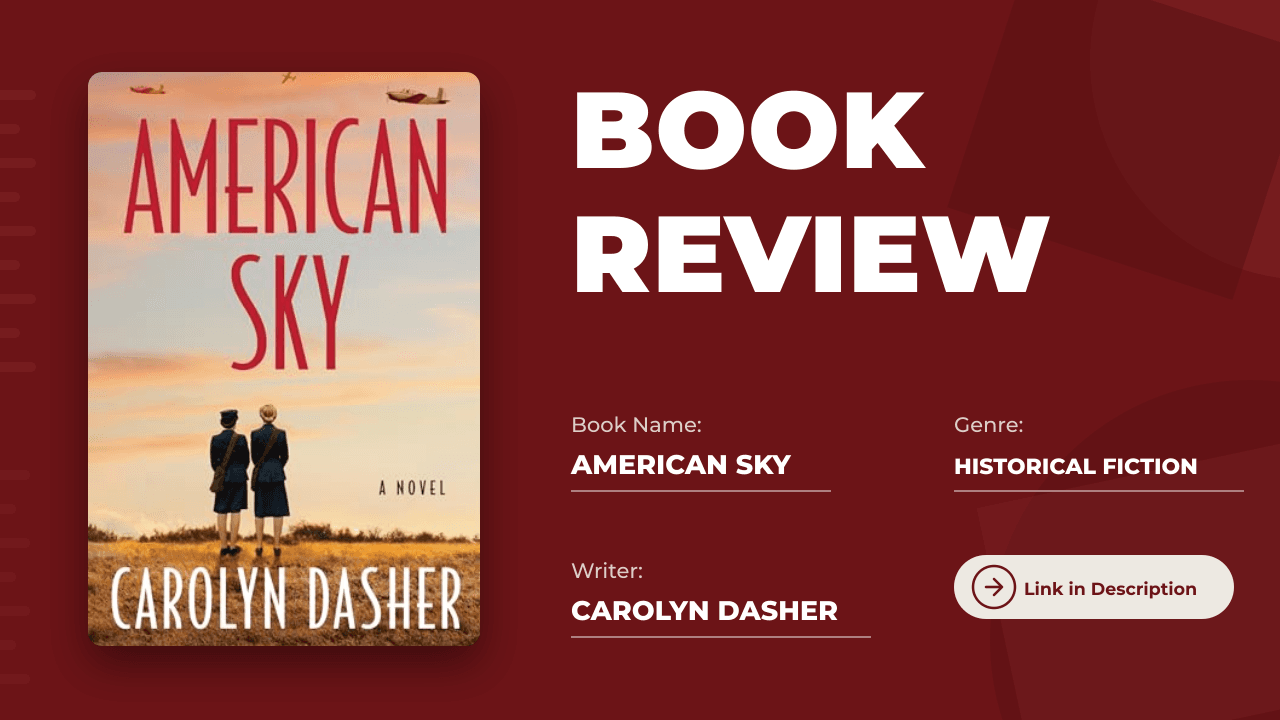
American Sky Review: What Happens to Women Pilots When the War Ends
- Sajjad
- Book Reviews
- 12 Sep, 2026
The hardest part of flying military aircraft in World War II wasn't earning the right to do it. For the women of the WASP program, it was what came after. American Sky by Carolyn Dasher opens with the thrill of that earned right, and then spends the rest of its nearly four hundred and fifty pages asking the harder question its title implies: what do you do with a life built around the sky once the country decides it doesn't need you up there anymore.
I picked up "American Sky" expecting a fairly straightforward WWII historical novel about trailblazing women pilots. What I got was that story as a launching point for something considerably larger, a three-generation family saga that follows the consequences of that grounding through the Vietnam era and into the lives of daughters who never got to fly at all. It's an ambitious structure for a debut novel, and it mostly earns that ambition, even when the later generations pull focus from the story that hooked me in the first place.
In this review, I'll cover the WASP program at the center of the book's opening chapters, the real history Dasher is drawing from, the friendship between George and Vivian that anchors the emotional core of the novel, the family secret that ties three generations together, and where the multigenerational structure asks more of the book than it can fully deliver. I'll also talk about what "American Sky" gets right about a piece of history most readers have never heard of.
Overview: What American Sky Is About

"American Sky" opens in the early twentieth century with Adele Clemson, a young Oklahoma woman who defies her mother's expectations by teaching herself to repair engines and raise livestock instead of settling into the housewife role assigned to her. That thread of quiet rebellion passes down to her daughter Georgeanne, known as George, a barnstormer's fan whose real dream is to fly. In 1943, George gets her chance, recruited into the newly formed Women Airforce Service Pilots program, where she meets Vivian Shaw, a fellow pilot who becomes something closer to a sister than a friend.
From there, the novel widens its lens considerably. George's own daughters, Ruth and Ivy, grow up in the shadow of a mother whose most vivid years happened before they were born, and their own paths, through the social upheaval of the Vietnam era, eventually intersect with a secret that's been sitting quietly at the center of the family the entire time. The book spans roughly seventy years and four generations of women, using the WASP program as its emotional and historical anchor even as the plot moves well beyond it.
The WASP Program and the History Most Readers Don't Know
What elevates "American Sky" above a generic wartime romance is how seriously Dasher takes the actual history of the Women Airforce Service Pilots. The WASP program was real: over a thousand women flew military aircraft during World War II, ferrying planes across the country, towing targets for live gunnery practice, and test-flying aircraft to free up male pilots for combat duty. They flew some of the fastest, most dangerous planes in the American arsenal, and thirty-eight of them died in service.
The book's title question isn't rhetorical. The WASP program was disbanded in December 1944, before the war in either theater had ended, and the women who'd flown for their country were simply sent home, without military benefits, without veteran status, and in many cases without so much as a funeral with honors for the ones who'd died in the line of duty. It would take until 1977, more than three decades later, for the WASP pilots to finally be granted military veteran status. Dasher builds George and Vivian's story directly out of that historical injustice, and the novel is strongest when it sits with exactly how disorienting it must have been to go from flying the country's most advanced aircraft to being told, almost overnight, that your only remaining job was to get married and stay home.
George and Vivian: Flying Together, Grounded Together
The friendship between George and Vivian is the emotional heart of the book's opening half, and it's drawn with real specificity. These aren't interchangeable heroines distinguished only by name, George is driven by a barnstorming-fueled love of flight that traces back to her mother's own quiet defiance, while Vivian carries the weight of a more troubled past and a family relationship strained in ways the book takes its time unpacking. Their bond deepens through the shared intensity of WASP training, and the sections depicting that training and the flying itself are where Dasher's prose comes most alive. The flight scenes read with a specificity and sensory detail that make clear how much research went into getting the mechanics and the feeling of it right.
The grounding, when it comes, hits harder because of how fully the book has invested in showing what these women had. Vivian doesn't accept the expected path quietly, and her refusal to simply become a housewife the way the country wants sets up much of what follows for the rest of the novel, including her ongoing, complicated presence in George's family for decades after the war technically ended for both of them.
The Secret That Ties Three Generations Together
Without giving away the full mechanics of the reveal, the novel's central secret involves hidden parentage that eventually surfaces in the next generation: Ivy, one of George's daughters, discovers that Vivian isn't merely a family friend but her biological mother. That revelation sends Ivy away from her family and toward independence, eventually landing her work as a journalist covering Vietnam, a path that mirrors her mother's generation's hunger to be somewhere more consequential than the domestic life expected of her.
Ruth, George's other daughter, takes the opposite route for most of the book, staying closer to home and more emotionally guarded, before eventually reconnecting with Vivian through flying lessons of her own. That reconnection gives the novel's back half its most satisfying throughline, a next-generation woman finding her way back to the sky through the same person who never fully let go of it herself.
Where the Multigenerational Structure Loses Some Altitude
I want to be honest about where "American Sky" strains under its own ambition. The decision to follow four generations across seventy years is a bold structural choice, and it mostly pays off, but it comes at a real cost to the WASP story that hooked me in the first place. As the novel moves into Ruth and Ivy's generation and the Vietnam War era, the specific, hard-won narrative of women succeeding as pilots in a man's world gets diluted by the sheer amount of additional plot the book is carrying. Readers who come to "American Sky" primarily for the WASP history, as I did, may find themselves wishing the novel had stayed in that world a little longer before widening its scope.
The pacing reflects this trade-off as well. The book settles into a fairly unhurried rhythm that allows for deep character work across its large cast, which works well for readers who want to sit with these women's inner lives, but may test the patience of readers expecting the more propulsive momentum of the opening WASP chapters to carry through the entire novel.
Carolyn Dasher's Prose and the Flying Scenes
As a debut novelist, Dasher's strongest instrument is clearly the flying itself. The sensory detail in the aviation sequences, the mechanics of the aircraft, the physical sensation of piloting these planes, gives the book a level of authenticity that elevates it above a more generic historical romance. Even readers with no particular interest in aviation history are likely to come away from "American Sky" with a genuine appreciation for what these women actually did in the cockpit, which is no small achievement for a first novel juggling this much historical and emotional ground.
Critical Reception and Reader Response
"American Sky" holds a strong 4.20-star average across more than 9,500 Goodreads ratings, a warm reception for a debut historical novel. Readers have praised it as "smart, immersive, and moving," with particular attention paid to how the flying scenes come alive on the page, and many have highlighted the novel's treatment of mother-daughter relationships and enduring female friendship as standout strengths.
The most consistent critical note, echoed by the Historical Novel Society among others, is that the central, most distinctive material, women succeeding as military pilots in a world built to keep them out of the cockpit, gets somewhat lost in the shuffle as the novel expands into later generations and different historical periods. That's a fair critique, and it's the same one I'd raise: the book is at its most singular in its WASP chapters, and the further it gets from them, the more it reads like a very good, but more familiar, multigenerational family saga.
How American Sky Fits Into WWII Women's Historical Fiction
Readers who enjoy novels centered on the overlooked contributions of women during World War II, whether that's codebreakers, factory workers, or in this case pilots, will find "American Sky" a worthy addition to that growing shelf. What distinguishes it is the specificity of the WASP program's real, largely unknown history, and Dasher's clear commitment to getting the aviation details right rather than treating the flying as set dressing for a more conventional romance plot.
Key Takeaways from American Sky
The WASP history is the book's strongest asset. Dasher's research into the real Women Airforce Service Pilots program grounds the novel in an injustice most readers won't already know about.
George and Vivian's friendship carries the emotional weight. Their bond, forged in training and tested by the abrupt end of their flying careers, is the most vivid relationship in the book.
The central secret connects the generations meaningfully. Ivy's discovery about Vivian gives the later chapters real emotional stakes rather than simply extending the timeline for its own sake.
The multigenerational scope has a real cost. The specific story of women succeeding as pilots gets diluted as the novel widens into later generations and different eras.
The flying scenes are worth the read on their own. Dasher's sensory, detailed depiction of piloting these aircraft is the clearest evidence of a writer who did her homework.
Conclusion: Is American Sky Worth Reading?
"American Sky" is a confident, well-researched debut that uses the real, underappreciated history of the WASP program to ask a question most WWII fiction doesn't bother with: what happens to the women who proved they belonged in the cockpit once the country decides it's done needing them there. George and Vivian's friendship, and the abrupt grounding that follows their service, are the novel's most powerful material, even as the broader multigenerational structure occasionally pulls focus from what makes this story distinctive.
If you're drawn to historical fiction that surfaces a piece of women's history you likely haven't encountered before, and you don't mind a slower-burn family saga carrying that history forward across decades, "American Sky" is worth your time. You can pick up a copy of "American Sky" on Amazon and see for yourself what it cost these women to fly, and what it cost them even more to be asked to stop.