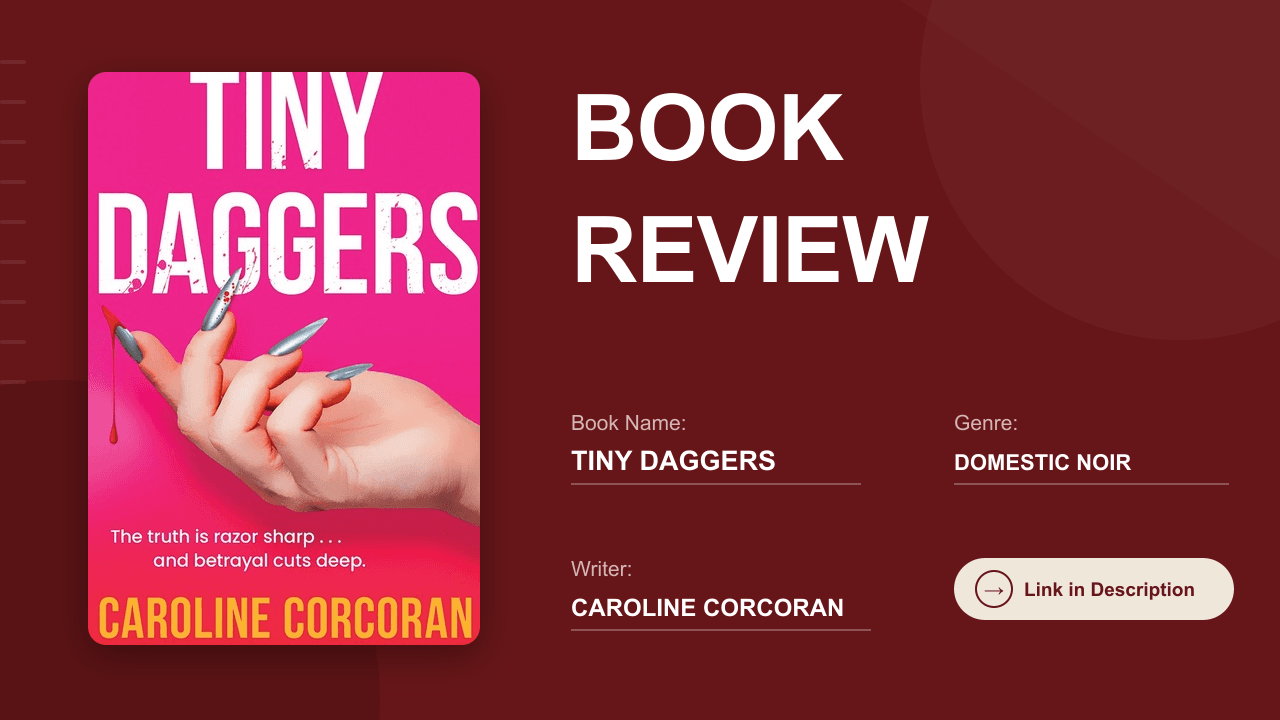
Tiny Daggers Review: Two Women Named Holly, and Neither One Is the Good One
- Sajjad
- Book Reviews
- 14 Sep, 2026
Every school has a Good One and a Bad One, and every adult who lived through that dynamic knows the labels were never quite accurate to begin with. Tiny Daggers builds its entire premise around forcing that reckoning two decades late, reuniting its Good Holly and Bad Holly in the sticky heat of elite Miami suburbia and daring the reader to keep track of which one actually deserves either title. By the time Caroline Corcoran is finished with them, the honest answer is neither, and that's the book's whole point.
I went into "Tiny Daggers" expecting a fairly standard toxic-female-friendship thriller, the kind where an old rivalry resurfaces and escalates toward something dark. What I got was exactly that premise, executed with real early momentum and a genuinely sharp eye for the specific cruelty of adult social competition, before the book's structural ambitions start working against it in ways that a lot of readers, myself included, found genuinely frustrating by the end.
In this review, I'll walk through Holly Jones's carefully built Miami life and the reappearance of Holly Wild after twenty years apart, how their old school dynamic gets weaponized into something much more dangerous in the present, the disappearance that frames the whole novel, and where the book's ambitious multi-part structure pays off versus where it collapses into confusion. I'll also talk honestly about the ending, because reader opinion on it is sharply divided, and it's exactly the kind of thing you'll want to know about before committing to this one.
Overview: What Tiny Daggers Is About
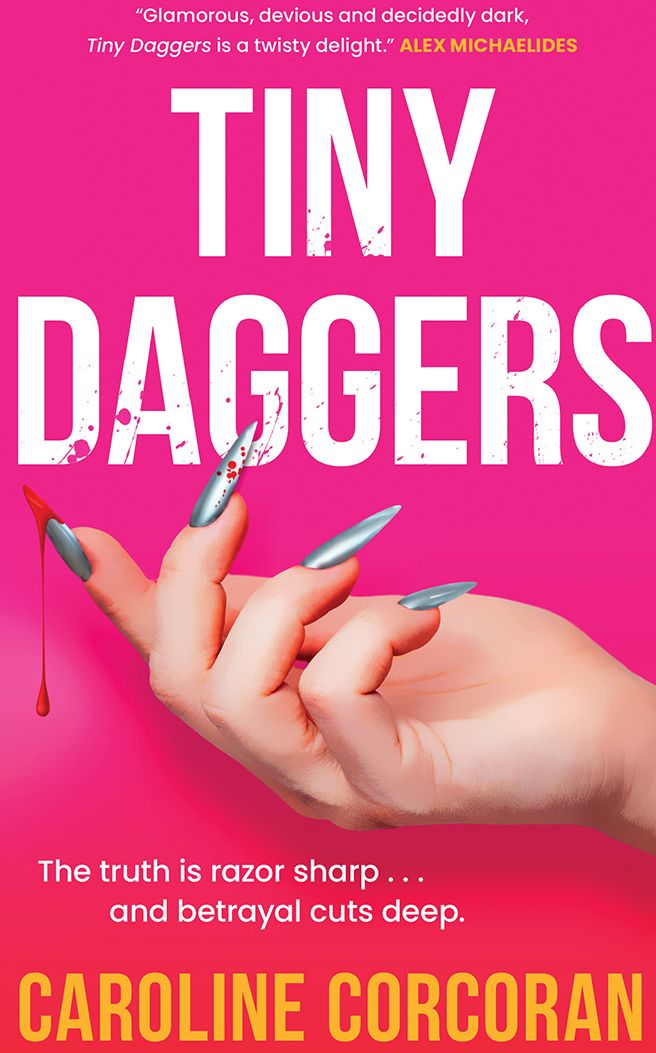
"Tiny Daggers" opens with a chilling discovery on a private hotel beach in the Florida Keys, immediately signaling that whatever happens between its two central women, something has gone seriously, irreversibly wrong by the time the book's present-day timeline catches up to it. From there, the novel rewinds to introduce Holly Jones, an expat who's spent years building an enviable life in an exclusive corner of Miami with her husband, Hugh, gated houses, social status, the whole carefully constructed picture of having made it.
That picture cracks the moment Holly runs into Holly Wild, a ghost from her London school days she hasn't seen in over twenty years. At school, the two were known, cruelly and simply, as Good Holly and Bad Holly, Holly Wild cast as the frumpy sidekick, Holly Jones as the golden girl everyone wanted to be near. Twenty years later, the dynamic has flipped in ways neither woman is quite prepared for: Holly Wild is single, sharp, and confident, a world away from her school-days reputation, and she wastes no time becoming an unavoidable presence in Holly Jones's life, in her home, in her marriage, and increasingly in her head, as their reunion curdles into an escalating game of cat and mouse where the old labels stop meaning anything at all.
Good Holly, Bad Holly, and a Rivalry That Never Actually Ended
The book's smartest move is refusing to let its central rivalry stay a simple grudge match. Corcoran gives both women distinct, credible voices and genuine, specific reasons to resent each other, resentments rooted deeply enough in their shared adolescence that the present-day escalation feels like the inevitable continuation of something that never actually got resolved, just paused for two decades. The "Good Holly and Bad Holly" framing itself becomes the book's real subject: how thoroughly two teenage girls can internalize labels assigned to them by their peers, and how much damage gets done trying to either live up to or escape those labels for the rest of their adult lives.
That's a genuinely rich vein for a domestic thriller to mine, and for the first stretch of the book, Corcoran mines it well. The early chapters read fast and pull the reader in effectively, building real paranoia around whether Holly Wild's reappearance is coincidence or calculated revenge, and whether Holly Jones's own increasingly unreliable perspective is accurately capturing what's actually happening around her.
Miami's Social Minefield and the Instagram-Era Anxiety Underneath It
Corcoran's rendering of elite Miami suburbia gives the book real contemporary bite. The sticky heat, the gated social competition, the specific, exhausting performance of a life that looks perfect from the outside, all of it functions as more than backdrop; it's the pressure cooker that makes Holly Wild's reintroduction into Holly Jones's world so destabilizing in the first place. The book's interest in Instagram-fueled inadequacy and the particular modern anxiety of measuring your life against a curated version of someone else's adds real thematic texture, tapping into something specific about how social comparison operates now versus how it operated in a school hallway twenty years ago, and finding real continuity between the two.
The Disappearance That Frames Everything
The Florida Keys hotel beach discovery that opens the novel hangs over the entire book, and Corcoran uses that framing device effectively to keep tension high even in stretches where the present-day plot is moving at a more measured pace. Readers know from the outset that this cat-and-mouse game between the two Hollys ends somewhere genuinely bad; the question the book is actually asking isn't whether something terrible happens, but which Holly it happens to, and why, and that structural choice does real work sustaining suspense across a novel that otherwise spends a lot of time in slower-burning social maneuvering.
Where the Structure Starts to Work Against Itself
I'd be underselling this review if I didn't flag where "Tiny Daggers" runs into real trouble. The novel is split into multiple parts, and while the shift into its second section is clearly designed to reframe everything the reader thought they understood about the first, several readers, and I'd agree, found that the twists arrive at the expense of coherence rather than in service of it. What starts as a tightly paranoid two-hander becomes considerably more tangled once the plot's larger machinery kicks in, and the accumulation of reveals in the back half strains credibility in ways the tense, grounded opening chapters didn't.
The two women sharing the same first name, a clever thematic choice on paper, becomes a genuine practical liability in execution; more than one reader found the repeated Holly-and-Holly confusion actively irritating rather than illuminating, particularly once the timeline starts jumping and the narrative voice shifts between them. A specific, oddly persistent mosquito metaphor also draws consistent criticism for overstaying its welcome, repeated often enough that it becomes a distraction rather than the evocative image it's clearly meant to be.
The ending is where opinion splits most sharply. Some readers found the eventual resolution a satisfying, earned payoff to the accumulated tension; others, more numerous in my read of the reception, found it arrives feeling random and unearned, with insufficient consequences for characters who've spent the whole book behaving genuinely badly. If you're the kind of reader who needs your thriller's ending to deliver real accountability, this is worth knowing about before you invest in the setup.
Caroline Corcoran's Craft: Sharp Wit, Uneven Follow-Through
None of that undercuts what Corcoran does well, particularly in the book's opening stretch. Her prose has real bite, and her ear for the specific, bitchy texture of adult female rivalry, the passive-aggressive social maneuvering, the performed friendliness masking genuine venom, is confident and often genuinely funny even as it's unsettling. Corcoran, a Sunday Times bestselling author and former journalist whose "domestic noir" novels have tackled subjects like infertility, domestic violence, and mental health, brings real craft to individualizing her two nearly-identical protagonists, giving them distinct enough voices that the shared name, irritating as some readers found it, doesn't fully collapse the book's ability to track who's who.
Where her execution falters is in sustaining that early control across a more structurally ambitious back half. The plot's escalating twists ask for a level of narrative discipline that the book doesn't always deliver, and the result is a novel whose second half genuinely divides readers on whether the payoff justifies the confusion required to get there.
How Tiny Daggers Compares to Corcoran's Other Work
Corcoran's broader body of work has established her as a writer willing to use the domestic thriller genre to examine real, difficult aspects of female experience, and "Tiny Daggers" continues that pattern by grounding its glossy Miami setting in something genuinely uncomfortable: the specific, lasting damage of the labels teenage girls assign each other and the adult lives built, consciously or not, in reaction to them. It's a more overtly social-satire-adjacent book than some of her other work, with one reviewer comparing its tone to "The White Lotus mixed with a sprinkle of Lisa Jewell and threads of 2000s chick lit," a description that captures the book's genuine tonal range even where its execution doesn't always match that ambition.
About Author Caroline Corcoran
Caroline Corcoran is a Sunday Times bestselling author and former journalist who contributed to publications including Grazia and Marie Claire before turning to fiction full-time. Her domestic noir novels consistently examine difficult aspects of the female experience, and "Tiny Daggers," her fifth novel and part of a multi-book deal with Thomas & Mercer, shows her continuing to push at the genre's more socially observant edges, even as this particular book's structural ambitions occasionally outpace its execution.
Critical Reception and Reader Response
"Tiny Daggers" holds a 3.67-star average across more than 5,500 Goodreads ratings and over 400 written reviews, a genuinely polarizing reception that splits fairly cleanly between readers who loved its twisty, morally grey energy and those who found the execution frustrating. Fans have praised the "twisty, dark" plotting and the sharp, bitchy character dynamics, with one reviewer's description of it as a "bitchy twisty thriller" capturing both the appeal and the intensity of readers' reactions to it.
The criticism clusters consistently around pacing and clarity: readers flagged slow pacing in the first part, confusing timeline jumps, and the shared-name device as a genuine source of frustration rather than clever ambiguity. Several reviewers noted the antagonists receive insufficient comeuppance given how badly they behave throughout, and a number of readers reported DNFing the book when the back half's twists stopped feeling earned. One especially critical review summed up the second half as losing its way entirely, with an ending that reads as "random and weird" rather than a satisfying culmination of the setup.
Key Takeaways from Tiny Daggers
The Good Holly/Bad Holly framing is the book's smartest idea. Refusing to let either woman actually deserve her old label gives the rivalry real thematic depth.
The Miami setting and social media anxiety add genuine contemporary bite. Corcoran connects modern Instagram-era comparison directly to the schoolyard dynamics that started it all.
The opening stretch is genuinely gripping. Sharp dialogue and real paranoia carry the first part of the book effectively.
The multi-part structure creates real clarity problems. Shared names, timeline jumps, and an escalating pile of twists undercut the tension the setup builds.
The ending divides readers sharply. Some find it an earned payoff; more seem to find it unsatisfying and undercooked given the setup's buildup.
Conclusion: Is Tiny Daggers Worth Reading?
"Tiny Daggers" opens with real confidence, a sharp, uncomfortable premise about two women whose adolescent labels never stopped shaping their adult lives, rendered with genuine wit and a keen eye for the specific cruelty of modern social competition. Caroline Corcoran clearly understands what makes this kind of toxic-friendship thriller work, and for a long stretch, the book delivers exactly that.
Where it falls short is in the follow-through: the structural ambition of its later parts introduces confusion the shared-name device doesn't help, and the ending leaves a meaningful portion of its readership unsatisfied with how little accountability its badly behaved characters actually face. If you're drawn to morally grey, twisty domestic thrillers and can forgive a back half that doesn't fully stick the landing, "Tiny Daggers" is worth the ride for its opening alone. You can pick up a copy of "Tiny Daggers" on Amazon and decide for yourself which Holly, if either, you're actually rooting for by the end.