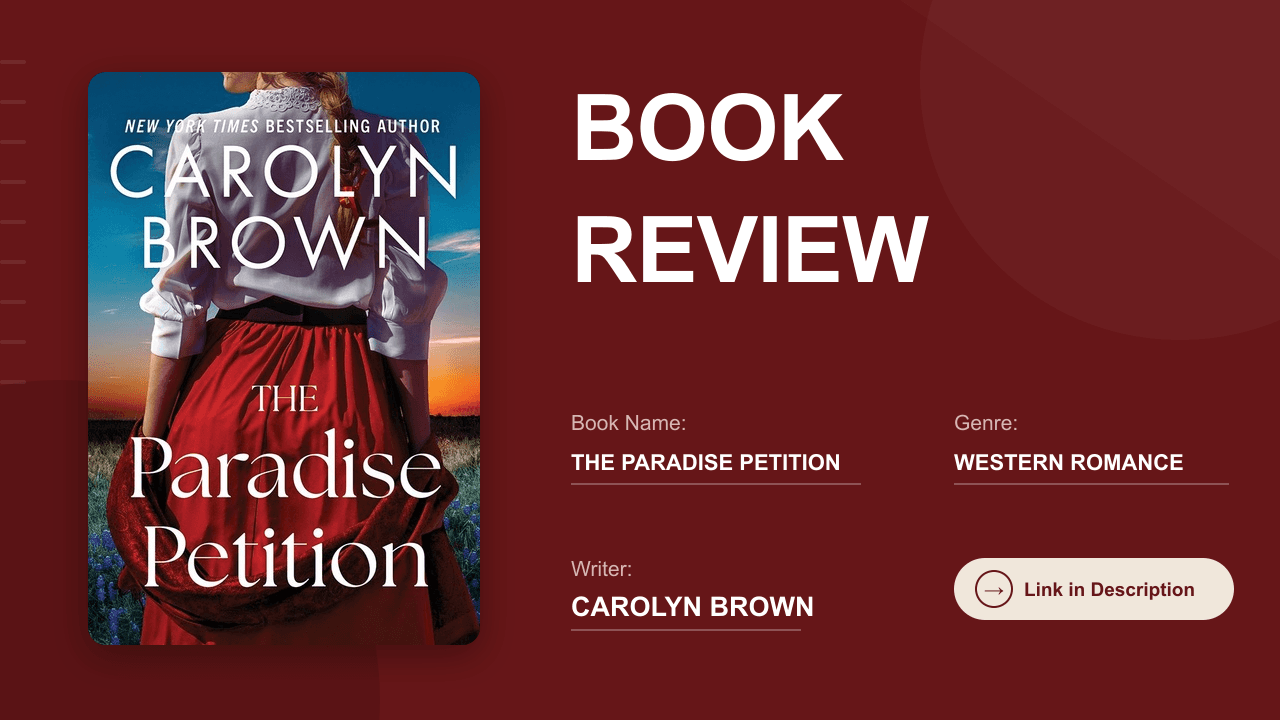
The Paradise Petition Review: Two Women With a Past Start a Women's Rights Movement in 1883 Texas
- Sajjad
- Book Reviews
- 14 Sep, 2026
Most historical romances that flirt with social commentary keep the commentary in the background, a period detail dressed up as texture. The Paradise Petition puts it front and center and dares the reader to enjoy it anyway, and mostly succeeds. Carolyn Brown gives her two leads a scandalous past, a fresh start built on a lie, and an actual list of demands they intend to hand to the men of their new town, and the book never pretends the second part is less important than the first.
I went into "The Paradise Petition" expecting a fairly standard Western romance with a feisty-heroine gimmick bolted onto a 1880s Texas backdrop. What I found instead was a genuinely committed story about two women rebuilding their lives from the wreckage of a career society wouldn't forgive, who decide that reinvention isn't enough on its own and set out to change the actual rules for every woman in their new town, not just themselves.
In this review, I'll walk through Daisy and Lily's arrival in Autrie under false pretenses, how their seamstress shop becomes the staging ground for an actual petition of women's rights, the Maguire brothers who end up more sympathetic to the cause than anyone expected, and where the book's commitment to its social themes strengthens the story versus where it occasionally overwhelms the romance. I'll also talk about the risk this book is taking, because a novel this explicit about its politics is going to land differently depending on what a reader came for.
Overview: What The Paradise Petition Is About
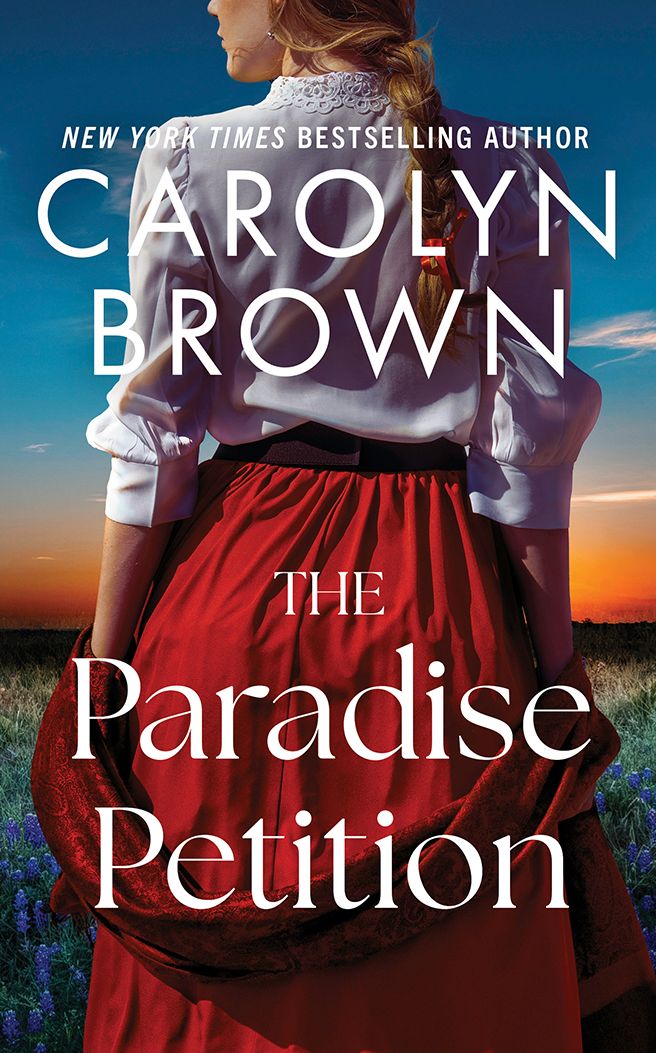
"The Paradise Petition" opens in 1883, when Daisy Lindberg and Lily Boyle step off a train in the small town of Autrie, Texas, introducing themselves as cousins looking to open a seamstress shop. That's true as far as it goes, but it isn't the whole story. Both women previously worked at Paradise, a brothel whose employees have since scattered across Texas, each hoping to build a respectable new life somewhere nobody recognizes them. Daisy and Lily's fresh start in Autrie depends entirely on that past staying buried.
It doesn't stay quiet for long, though not in the way a lesser book might have used it. Daisy and Lily settle in, open their shop, and fall in with Beulah, a formidable local shop owner, and Alma, a preacher's wife who's reached her breaking point with how little say she has over her own life. Together, the four women form an auxiliary group that starts as a support network and quickly becomes something more ambitious: a genuine petition demanding rights the women of Autrie don't currently have, the ability to own property, travel without a male escort, retain some control over their own children, and simply be treated as adults rather than property themselves.
Daisy and Lily: Reinvention as an Act of Defiance
What makes the setup work is that Brown never treats Daisy and Lily's past as a shameful secret the plot exists to punish them for. Their time at Paradise is presented plainly, as a circumstance of the era's limited options for women without money or family protection, rather than a moral failing that needs atoning for across 283 pages. That's a meaningful choice for a Western romance to make, and it sets the tone for everything the book does afterward: these are women who understand exactly how little control they've historically had over their own lives, because they've lived the sharpest version of that powerlessness already.
Their decision to organize Autrie's women isn't framed as an abstract political awakening, it's a direct extension of what they already know. Daisy and Lily aren't theorizing about women's rights from a position of comfort, they're building a movement out of hard-won, specific knowledge of what happens to women who have no legal standing and no say in their own futures. That grounding gives the book's politics real weight instead of letting them feel like a modern argument dropped into a period costume.
The Petition Itself: Specific, Practical, and Genuinely Radical for 1883
The book's strongest structural choice is how concrete it makes the women's demands. This isn't a vague call for equality; it's an actual list, the right to sit with their husbands in church instead of being segregated, the right to teach after marrying, the right to walk into town without a male escort, the freedom to wear pants, an end to domestic violence being treated as a private matter. Seeing those demands laid out specifically does more work than a general theme of "women deserve better" would, because it forces the reader to sit with just how narrow women's actual legal and social standing was in this period, item by item.
When the women eventually escalate to a strike to force the issue, the book earns that turn because it's already shown its work. The demands aren't a plot device dropped in to manufacture conflict, they're the logical endpoint of everything Daisy, Lily, Beulah, and Alma have already experienced and organized around. It's a smarter piece of plotting than "feisty women vs. small-town men" premises usually bother with.
The Maguire Brothers: Allies Without Being Saviors
Balancing out the town's general skepticism are the Maguire brothers, Elijah, Matt, and Claude, who end up more receptive to the women's cause than anyone in Autrie expects. Matt Maguire, a sheep rancher, becomes Lily's love interest and gives the book its clearest example of male support that doesn't tip into the men simply rescuing the women's movement for them. Matt's sympathy for women's independence is established as consistent with who he already is rather than a conversion arc engineered by his attraction to Lily, and Claude's parallel interest in Daisy follows a similar pattern.
It's a careful line to walk, giving the romance genuine warmth without letting the men's approval become the thing that legitimizes the women's demands, and Brown mostly holds that line. The Maguires are allies, not architects, and the book is better for keeping the actual organizing work with Daisy and Lily rather than handing it to the men who happen to agree with them.
Where the Social Themes Outpace the Romance
I'd be underselling this review if I didn't flag where the book's priorities show. The romantic subplot with Matt and Claude Maguire is warm and well-handled but genuinely minor relative to the women's rights plot, and readers coming to this expecting a Western romance with social commentary as seasoning, rather than the reverse, may find the balance surprising. This is, at its core, a book about a movement first and a love story second, and Brown's commitment to that ordering is admirable but worth knowing going in.
The book also doesn't shy away from real hardship along the way, storms, rattlesnakes, the physical dangers of frontier life alongside the social ones, and prejudice that goes beyond polite skepticism into genuine hostility toward what Daisy and Lily are building. Some of these obstacles resolve more easily than the setup suggests they should, and a few plot turns lean on convenient timing to keep the story moving toward its hopeful ending. The book is, above all, committed to optimism about what collective action can accomplish, and that commitment occasionally smooths over conflicts that a grittier take on the same material might have let sit longer.
Carolyn Brown's Voice: Warm, Witty, and Unapologetic
None of that undercuts what Brown does well here. Her prose stays light and readable even while handling material that could easily turn didactic, and her ear for period-appropriate banter keeps the auxiliary group's meetings genuinely funny even when they're laying out serious grievances. Brown, a New York Times bestselling author with a deep bibliography of Texas-set romance and women's fiction, brings real craft to balancing the entertainment value against the book's unwavering commitment to its feminist themes, and that balance is the main reason the social commentary never feels like a lecture.
The secondary characters, Beulah's practical toughness, Alma's quiet desperation finally finding an outlet, give the ensemble real texture beyond Daisy and Lily's central friendship. The auxiliary group reads as a genuine community rather than a collection of talking points, which is exactly what a book this invested in collective action needs to get right.
How The Paradise Petition Compares to Brown's Other Work
Readers familiar with Carolyn Brown's other Texas-set romances and her Cadillac Series women's fiction will recognize her interest in tight-knit female friendships and small-town settings that function as their own kind of character. "The Paradise Petition" pushes further into explicit social commentary than a lot of her catalog, trading some of the genre's usual romantic centering for a story more interested in collective female agency than any single couple's happy ending. It's a bolder swing than a standard Western romance, and it mostly justifies the risk by keeping its politics specific and grounded rather than abstract.
About Author Carolyn Brown
Carolyn Brown is a New York Times bestselling author with a prolific career spanning cowboy romances, contemporary and historical Texas-set fiction, and women's fiction series like the Cadillac Series. "The Paradise Petition," published by Montlake in July 2025, shows her willing to use the Western romance framework for more overtly political storytelling than usual, and her comfort with ensemble casts and small-town dynamics carries the larger structure of the book even when the central romance takes a back seat to the women's organizing.
Critical Reception and Reader Response
"The Paradise Petition" has drawn a solidly positive, if not universally rapturous, reception, with reviewers landing in the 3.5-to-3.8-star range. Readers have consistently praised Daisy and Lily as "strong, warm, and complex" characters, and the book's mix of historical grievance and genuine humor has been called "heartwarming" and full of "more than a few surprises" that keep the pacing engaging across its runtime. The audiobook edition, narrated by Brittany Pressley, has also been specifically praised for its performance.
The criticism that surfaces most consistently is about balance: some readers found the romantic subplot with the Maguire brothers thin relative to the women's rights plot, and a few noted the book's messaging is delivered with unwavering conviction rather than more nuance or ambiguity, which works well for readers aligned with the story's politics and lands as a bit heavy-handed for readers who wanted the social commentary to stay more in the background.
Key Takeaways from The Paradise Petition
Daisy and Lily's past is treated with real dignity. Their history at the Paradise brothel is presented as circumstance rather than shame, which grounds the book's politics in lived experience.
The petition's demands are specific, not abstract. Concrete asks, church seating, teaching rights, freedom of movement, an end to treating domestic violence as private, give the social commentary real weight.
The Maguire brothers support without overshadowing. Matt and Claude's sympathy for the women's cause is consistent with who they are, not a conversion the plot needs to manufacture.
The romance takes a back seat to the movement. Readers expecting a more evenly balanced romance will find the women's rights plot is clearly the book's priority.
The tone stays warm even while tackling real hardship. Storms, prejudice, and frontier danger are present, but Brown keeps the book's overall register hopeful rather than bleak.
Conclusion: Is The Paradise Petition Worth Reading?
"The Paradise Petition" is a genuinely committed piece of historical fiction that uses its Western romance framework to tell a specific, well-researched story about what it actually took for women to demand basic legal standing in 1880s Texas. Daisy and Lily are compelling leads precisely because their past informs their politics rather than existing as a separate plot thread, and the petition itself, concrete, practical, and quietly radical for its era, gives the book a spine that a lot of genre fiction with similar ambitions doesn't bother building.
It leans harder into its social themes than its romance, and readers looking for an evenly balanced love story should adjust their expectations accordingly. But as a warm, witty account of collective female defiance dressed in Western romance clothing, "The Paradise Petition" delivers something genuinely different from most books in its genre. You can pick up a copy of "The Paradise Petition" on Amazon and see whether Daisy and Lily's petition wins over Autrie the way it's won over most of its readers.