The Answer Is No Review: Backman's Frying Pan Satire Is Sharper Than You'd Expect
- Sajjad
- Book Reviews
- 12 Sep, 2026
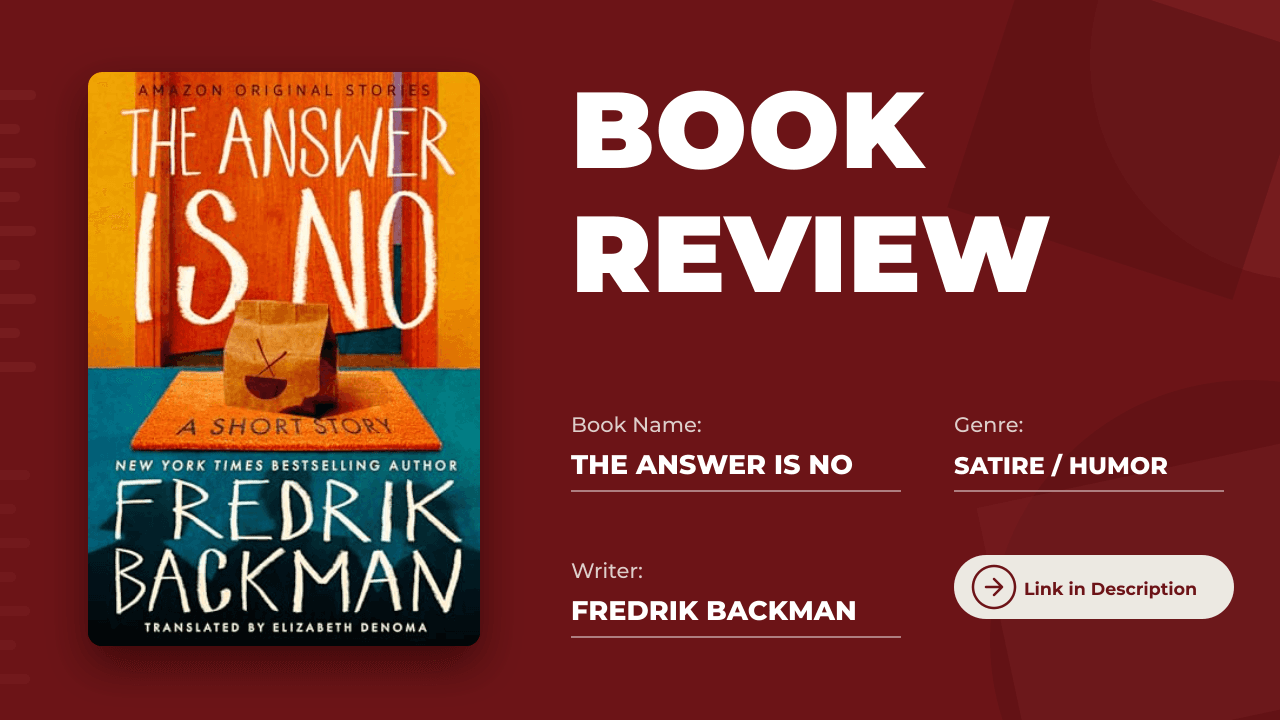
A discarded frying pan shouldn't be able to hold up an entire short story, let alone say something true about modern life. The Answer Is No by Fredrik Backman manages it anyway, turning one man's refusal to get involved in a minor neighborhood dispute into a compact, surprisingly sharp satire of everything that makes staying out of other people's business so difficult these days.
I picked up "The Answer Is No" expecting a light, quick read, the kind of Amazon Original Story you finish in an afternoon and mostly forget by the following week. What I got instead was a story that's genuinely funny in its first half, occasionally uneven in its second, and consistently smarter than its premise suggests. A man just wants to be left alone with his frying pan situation. The world, predictably, will not allow it.
In this review, I'll cover the setup with Lucas and the apartment board, the escalating chaos that follows, the satire Backman is aiming at underneath the comedy, and where the story's momentum wobbles in its back half. I'll also talk about how "The Answer Is No" fits into Backman's larger body of work, because fans of "A Man Called Ove" will recognize the DNA here immediately, just compressed into a fraction of the space.
Overview: What The Answer Is No Is About

"The Answer Is No" introduces us to Lucas, a man who has his life exactly the way he wants it: video games, a decent bottle of wine, and pad thai with peanuts, ideally enjoyed without another human being in the room. He's not miserable or friendless in some sad, cautionary-tale way, he's simply content, which is a state of being the story treats as almost radical.
That contentment doesn't last. The apartment board, described elsewhere as a "three-headed hydra" of petty authority, shows up at his door because someone left a frying pan next to the recycling room overnight, and they've decided Lucas is the one who's going to help them get to the bottom of it. When Lucas suggests the obvious solution (just throw the pan away), the board refuses. They need to find the guilty party. What follows is a chain reaction of escalating, absurd consequences that Lucas never asked for and can't seem to opt out of, no matter how many times he tries.
Lucas and the Board: A Comedy of Willful Misunderstanding
The engine of this story is the mismatch between what Lucas wants (nothing) and what the board wants (a resolution, an investigation, and apparently his full participation in both). Backman gets a lot of comic mileage out of how reasonable Lucas sounds and how unreasonable the board is while still believing themselves to be the reasonable ones. It's a familiar dynamic if you've ever dealt with a homeowners' association, a building committee, or any small group of people who've been granted a tiny amount of institutional power and intend to use every bit of it.
The board members function less as individual characters than as a single comic organism, the "three-headed hydra" descriptor several reviewers have landed on feels exactly right. They don't need distinct personalities because the joke isn't about who they are, it's about what they represent: officious busybodies who mistake activity for competence, and who'd rather manufacture a crisis than let a stray frying pan quietly disappear.
The Satire Underneath the Comedy
What elevates "The Answer Is No" above a simple odd-couple farce is what Backman is actually satirizing: the exhausting expectation that everyone participate in communal life, whether they want to or not. Lucas isn't hostile or antisocial in any way that would make him hard to sympathize with, he just wants to be left to his own devices, and the story treats that desire as legitimate rather than a character flaw to be corrected by the end.
Backman extends the satire outward from the board itself into the wider machinery of forced modern sociability: neighborhood group chats, community social media pages, and the general expectation that every minor disagreement deserves an audience and an opinion from everyone nearby. One of the story's sharper observations, paraphrased from its own text, is that asking people what they think is how you get them to start thinking, and that's how arguments (and eventually wars) start. It's a joke, but it's also making a real point about how much conflict gets manufactured simply because someone insisted on airing it out loud instead of letting it go.
Where the Story Loses Some of Its Footing
I want to be honest about where "The Answer Is No" doesn't fully sustain its own energy. The first half of the story, centered tightly on Lucas and the board's initial confrontation over the frying pan, is genuinely the funniest and sharpest material here. Once the conflict spills outward into neighborhood social media groups and a wider cast of neighbors gets pulled in, the satire loses some of its precision. The jokes keep coming, but the target gets fuzzier, and the tight, absurdist logic of the opening chapters gives way to a broader, less focused kind of chaos.
The ending also moves fast, perhaps faster than the character work earlier in the story quite earns. Lucas's arc, such as it is, resolves in a way that feels more like the story running out of pages than a fully developed change in how he sees the world. For a story this short, that's a forgivable compression, but it's noticeable, and it's the main reason "The Answer Is No" reads as a very good short story rather than a great one.
Backman's Voice in a Tighter Format
Fredrik Backman's fans will recognize his sensibility immediately: warm but clear-eyed about human absurdity, quick with a line that's funny on the surface and a little sad underneath it. At just under seventy pages, "The Answer Is No" doesn't have room for the slow-building emotional architecture of "A Man Called Ove" or "Beartown," but it compresses the same core instinct, that people are simultaneously exhausting and worth paying attention to, into something you can read in one sitting.
Translator Elizabeth DeNoma keeps Backman's voice intact here, the same dry, observational humor that's carried his novels translates cleanly into this much shorter form. The prose doesn't waste space on scene-setting or elaborate description, it moves quickly from one absurd escalation to the next, which suits a story about a man trying and failing to avoid getting pulled into something.
Critical Reception and Reader Response
"The Answer Is No" has been read widely since its December 2024 release, holding a 3.90-star average across more than 130,000 Goodreads ratings, an unusually large number for a short story and a sign of how far Backman's readership reaches. Reviewers have consistently praised the first half as laugh-out-loud funny, with the board's officious meddling and Lucas's deadpan resistance to it singled out as the story's strongest material.
The criticism tends to track what I noticed as well: several reviewers flagged the story's back half, once neighborhood social media groups enter the picture, as losing some of the sharpness of the opening chapters, with one reviewer giving the story an overall B grade for exactly that reason. Other readers rated it a full five stars, describing it as a quick, satisfying palate cleanser between longer reads, and praising Backman's ability to find something touching underneath the comedy of a man just trying to protect his own solitude.
How The Answer Is No Compares to Backman's Other Work
If you've read "A Man Called Ove," you'll recognize the template immediately: a prickly, solitary protagonist who wants the world to leave him alone, surrounded by well-meaning but intrusive people who won't. "The Answer Is No" strips that formula down to its most efficient version, no slow-burn backstory, no long game of emotional thaw, just the comic set piece itself, delivered fast. It won't hit with the same emotional weight as Backman's full-length novels, but it's a good demonstration of how well his instincts for character and absurdity travel even in a much smaller space.
Key Takeaways from The Answer Is No
Wanting to be left alone is treated as valid. Lucas isn't punished narratively for his introversion, which is a more generous stance than this kind of story usually takes toward its solitary protagonist.
The board works because it's a single comic organism. Backman doesn't need to individuate the "three-headed hydra" for the satire to land, their collective officiousness is the joke.
The satire aims at forced modern sociability. Group chats, community pages, and the expectation of universal participation are the real targets here, not any one person.
The back half loses some precision. Once the conflict widens beyond Lucas and the board, the jokes keep coming but the satire gets less focused.
It's Backman in miniature. Fans of "A Man Called Ove" will recognize the sensibility instantly, just compressed into a single sitting instead of a full novel.
Conclusion: Is The Answer Is No Worth Reading?
"The Answer Is No" is a quick, genuinely funny short story that turns a stray frying pan into a surprisingly effective satire of how exhausting it is to simply want to be left alone in a world that keeps insisting on your participation. The first half is Backman at his sharpest, and even where the second half loses some of its focus, the story is short enough that it never overstays its welcome.
If you're looking for a fast, funny read that still has something real to say about modern life's low-grade social pressure, or if you're already a Backman fan looking for something to read between his novels, "The Answer Is No" is worth the hour it takes to finish. You can pick up a copy of "The Answer Is No" on Amazon and decide for yourself whether Lucas ever gets his peace and quiet back.