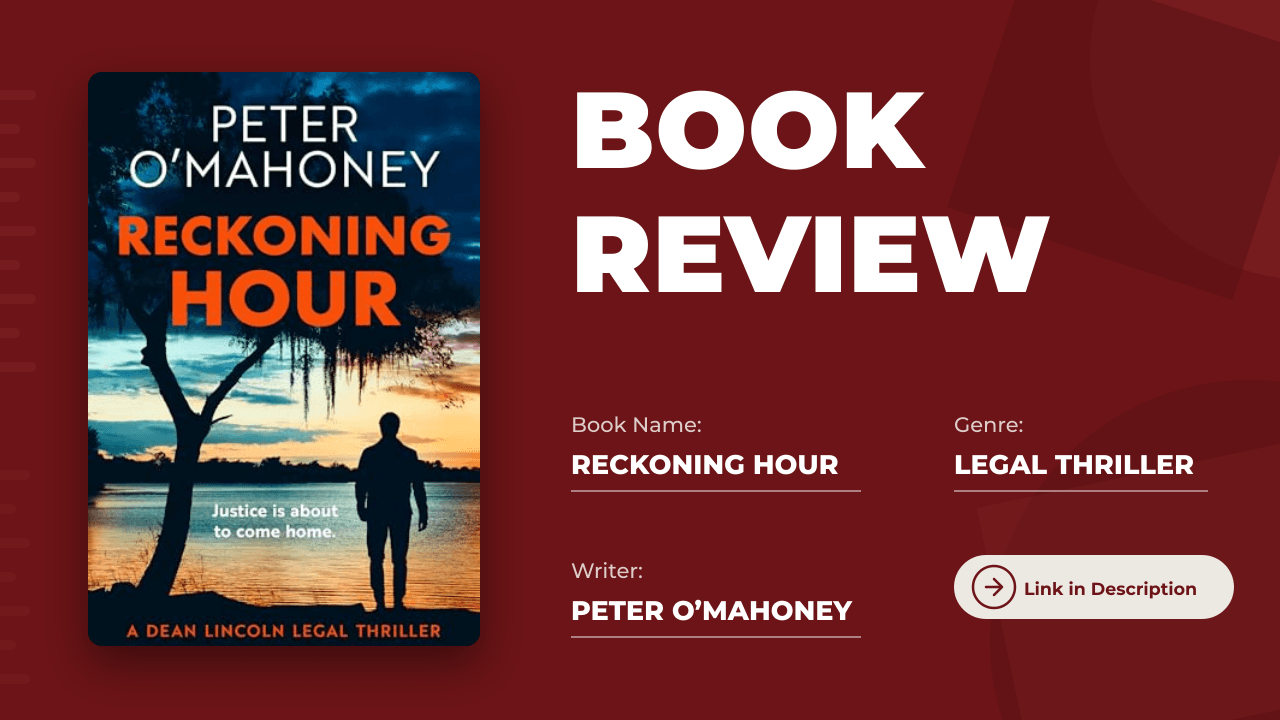
Reckoning Hour Review: A Southern Courtroom Thriller That Earns Its Twists
- Sajjad
- Book Reviews
- 12 Sep, 2026
Some legal thrillers make you wait until the final chapter to earn their twist. Reckoning Hour by Peter O'Mahoney isn't interested in waiting that long. From the moment defense attorney Dean Lincoln drives back into his sleepy hometown of Beaufort, South Carolina, the novel starts stacking pressure on him from every direction, and it keeps stacking until the courtroom becomes the only place left where the truth can actually surface.
I picked up "Reckoning Hour" expecting a fairly standard small-town legal drama. What I got instead was a book that leans hard into its Southern gothic setting, gives its protagonist a genuinely messy past to wrestle with, and juggles two separate criminal cases without ever losing the thread between them. It's the first entry in O'Mahoney's new Dean Lincoln Legal Thriller series, and it does the job a series opener is supposed to do: it introduces a compelling lead, plants seeds that clearly matter for future books, and delivers a self-contained mystery that pays off by the final pages.
In this review, I'll walk through the setup, the two cases at the center of the plot, the themes of privilege and old grudges that run underneath the courtroom scenes, and how Dean Lincoln stacks up as a protagonist. I'll also be honest about where the book stumbles, because "Reckoning Hour" isn't a flawless read, and a review that only praises a book isn't much use to anyone deciding whether to spend their next few evenings with it.
Overview: What Reckoning Hour Is About

"Reckoning Hour" follows Dean Lincoln, a defense attorney who's built a career in the city but finds himself pulled back to Beaufort, the picturesque, moss-draped town he thought he'd left behind for good. He isn't home long before he's handed two cases that couldn't be more different on paper: a wealthy teenager charged with murder, and a poor kid accused of arson. Both defendants insist they're innocent, and both cases quickly reveal that Beaufort's version of justice doesn't run on the same rules Lincoln learned in the big city.
What makes the setup work is that O'Mahoney doesn't treat the two cases as a simple A-plot and B-plot. They're woven together, both testing Lincoln's ability to separate the law from the town's unspoken hierarchy, and both circling back to a grudge against Lincoln that predates either case. His return to Beaufort has stirred something up, and the novel makes it clear early on that this isn't just professional risk. It's personal, and it eventually threatens his career, his clients, and his safety in equal measure.
The Two Cases at the Heart of the Story
The murder case involves a defendant from Beaufort's moneyed class, the kind of family whose name opens doors and closes mouths. The arson case involves a defendant with none of those advantages, a poor kid who doesn't have the resources or the social capital to get the benefit of the doubt. O'Mahoney uses the two cases in parallel to make an argument without ever stating it outright: that the presumption of innocence is a lot easier to access when you already look innocent to the people deciding your fate.
I appreciated that the book doesn't resolve this tension in a tidy, message-driven way. Instead, it plays out through procedure. We watch Lincoln build both defenses, chase down witnesses who don't want to talk, and run into a local legal system that treats "the rules" as more of a suggestion when the right last name is involved. The courtroom scenes for both cases are where the novel is at its strongest. O'Mahoney writes cross-examinations with real rhythm, and the reveals inside the trials land because the groundwork for them was laid several chapters earlier, not invented in the moment to manufacture a surprise.
Beaufort, South Carolina as a Character in Its Own Right
If there's one thing "Reckoning Hour" gets right without question, it's atmosphere. Beaufort is rendered as a town of oak-lined streets, water views, and a surface-level charm that hides exactly how much everyone knows about everyone else. O'Mahoney treats the setting almost like a witness in the story: it has seen everything, it remembers everything, and it's not always willing to say what it saw.
This matters because the plot depends on the idea that small towns keep score differently than cities do. Old grudges don't fade in Beaufort, they get filed away and waited on. Lincoln's return isn't just a homecoming, it's a reopening of accounts that people assumed were settled. The novel uses its setting to justify why a defense attorney with the skill to work anywhere would suddenly find himself fighting battles that have nothing to do with the law and everything to do with history.
Themes of Privilege, Justice, and Old Grudges
Underneath the two cases, "Reckoning Hour" is really asking a single question: does justice actually work the same way for everyone, or does it just look like it does from a distance? The murder case gives O'Mahoney room to explore how wealth insulates people from suspicion, while the arson case shows how quickly a poor defendant can be treated as guilty before a single piece of evidence is presented.
The novel also digs into the idea that the courtroom isn't always where guilt gets decided. Reputation, rumor, and the social standing of a family can convict or acquit someone long before a jury is seated. Lincoln spends much of the book fighting two trials at once: the one in front of the judge, and the one happening in the diners, church pews, and porches of Beaufort. That second trial is arguably the more dangerous one, since it's the one that eventually turns on him personally.
Dean Lincoln: A Complicated Hero Worth Following
Dean Lincoln works as a protagonist because he isn't written as a flawless crusader. He's sharp in the courtroom, but he's also someone running from a past he clearly hasn't made peace with, and the novel is smart about doling out that backstory in pieces rather than dumping it all in a prologue. By the time the full picture of why he left Beaufort (and why coming back was never going to be simple) comes into focus, it recontextualizes almost every earlier scene.
I found Lincoln most compelling in the moments where his professional instincts and his personal history are in direct conflict, when the smartest legal move isn't the same as the move that protects the people he still cares about in this town. That friction is what keeps "Reckoning Hour" from feeling like a case-of-the-week procedural with a Southern accent. Lincoln has skin in the game beyond winning, and the book is better for it.
Peter O'Mahoney's Courtroom Craft
O'Mahoney clearly knows how to build a trial scene. The pacing inside the courtroom is tight, the examinations are structured with a clear sense of strategy, and the reveals during testimony feel earned rather than convenient. This is where "Reckoning Hour" justifies the "earns its twists" part of its reputation: the late-book turns aren't pulled from nowhere. They're the payoff of details O'Mahoney planted early, which is exactly what you want from a legal thriller and exactly what a lot of them fail to deliver.
Outside the courtroom, the prose is efficient rather than lyrical. O'Mahoney isn't reaching for literary flourish here, he's moving the plot, and for a thriller built around procedure and pressure, that's the right call more often than not.
Where the Southern Drawl Gets Repetitive: A Fair Critique
I'd be doing this review a disservice if I only talked about what works, because "Reckoning Hour" has a genuine weak spot, and it's one plenty of readers have flagged: the town's "we do things differently here" attitude gets repeated so often that even Lincoln himself seems worn down by hearing it. The Southern setting is one of the book's biggest strengths, but O'Mahoney occasionally leans on the same regional shorthand and dialect cues instead of trusting the atmosphere he's already built to carry the mood on its own.
It's a fair criticism, and it shows up most in the secondary characters, whose dialogue can feel more like a collection of Southern-thriller signifiers than fully lived-in voices. It doesn't sink the book, since the plotting and courtroom work are strong enough to carry it, but readers who are sensitive to genre stereotypes will likely notice the repetition before they're halfway through.
About Author Peter O'Mahoney
Peter O'Mahoney is a bestselling author known for legal thrillers, including his Joe Hennessy, Tex Hunter, and Jack Valentine series. His background in psychology and criminology, and his standing as an active member of the American Society of Criminology, shows up in how methodically "Reckoning Hour" handles the mechanics of a criminal case. By his own account, O'Mahoney grew up on a steady diet of Perry Mason stories, and that influence is easy to spot in how much faith the book places in the courtroom as the place where a story's real tension gets resolved.
"Reckoning Hour" launches the Dean Lincoln series, and O'Mahoney leaves enough threads loose, particularly around Lincoln's history in Beaufort, to suggest the grudges from this book aren't fully settled yet.
Critical Reception and Reader Response
"Reckoning Hour" has built a strong reader following since its release, holding a 4.29-star average across nearly 15,000 Goodreads ratings. Readers consistently point to the same strengths I found: genuinely suspenseful courtroom scenes, a setting that does real narrative work instead of just sitting in the background, and a protagonist with more emotional depth than the genre usually bothers to provide.
The criticism tends to cluster around the same issue I raised above, the town's dialogue occasionally tipping into Southern cliché, along with a writing style some readers found more workmanlike than literary. That mixed reception feels accurate to me. This is a book with clear, specific strengths and one clear, specific weakness, rather than one that's universally beloved or universally panned.
How Reckoning Hour Compares to Other Southern Legal Thrillers
Readers who enjoy John Grisham's small-town legal dramas will find familiar territory here, a defense attorney who's an outsider and an insider at the same time, a community that protects its own, and a case that turns out to be about a lot more than the crime on the docket. Where "Reckoning Hour" distinguishes itself is in running two cases simultaneously rather than one, using the contrast between a privileged defendant and a disadvantaged one to say something about the town without slowing down the plot to say it directly.
Key Takeaways from Reckoning Hour
Justice isn't blind in Beaufort. The novel makes a compelling case that wealth and reputation shape outcomes long before a jury is seated.
A strong setting can carry a plot. Beaufort's atmosphere does as much narrative heavy lifting as any single character.
Earned twists beat convenient ones. O'Mahoney plants his reveals early, which makes the payoffs late in the book feel legitimate rather than manufactured.
A flawed protagonist reads as a real one. Dean Lincoln's unresolved history with Beaufort gives the courtroom stakes personal weight.
Genre shorthand has a ceiling. Leaning on Southern dialect and small-town tropes works until it starts repeating itself, and this book brushes up against that ceiling more than once.
Conclusion: Is Reckoning Hour Worth Reading?
"Reckoning Hour" is a confident opener to a new legal thriller series, one built on strong courtroom craft, a setting with real teeth, and a protagonist whose past gives every case personal stakes. It isn't a perfect book. The Southern-town dialogue occasionally repeats itself past the point of usefulness, and readers looking for prose with more literary ambition may find O'Mahoney's style more functional than memorable. But as a thriller built to keep you reading late into the night and to set up a series worth following, it delivers.
If you're in the mood for a courtroom drama that trusts its twists to earn themselves rather than ambush you, "Reckoning Hour" is worth the time. You can pick up a copy of "Reckoning Hour" on Amazon and see for yourself whether Dean Lincoln's homecoming lives up to the reputation it's built among readers.