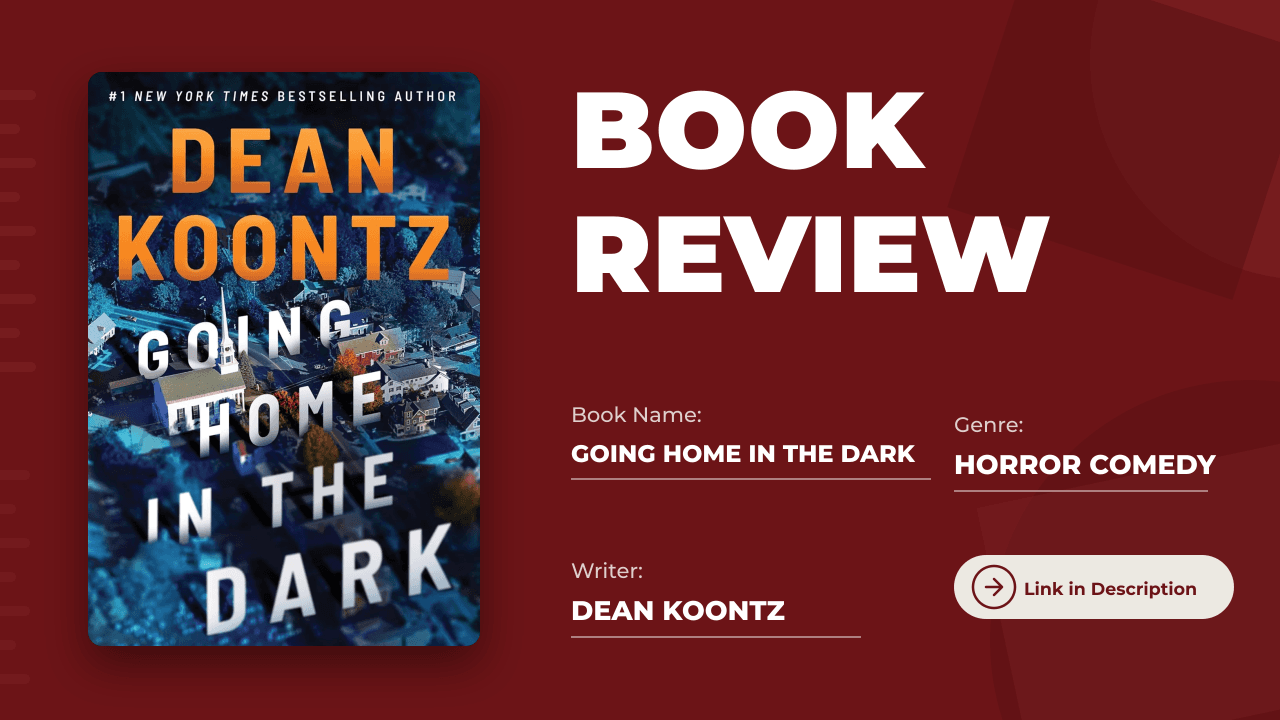
Going Home in the Dark Review: Koontz Plays It for Laughs and Still Makes It Terrifying
- Sajjad
- Book Reviews
- 12 Sep, 2026
Dean Koontz has spent decades proving he can scare readers. What he's doing in Going Home in the Dark is riskier: he's trying to make you laugh in the same breath he makes your skin crawl, and betting that the horror survives the joke. It mostly does, which is the whole reason this book is worth talking about.
I went into "Going Home in the Dark" expecting a fairly standard Koontz small-town thriller, the kind where an idyllic setting hides something rotten underneath. What I got was that premise filtered through a narrator who keeps interrupting himself, characters who crack jokes in the middle of genuinely disturbing scenes, and antagonists so strange that describing them accurately sounds like a punchline even when the book means them dead seriously. It's an odd combination, and it doesn't always land smoothly, but when it works, it works in a way I haven't seen from Koontz in years.
In this review, I'll walk through the setup in Maple Grove, the childhood friends at the center of the story, the strange threat waiting for them back home, and how Koontz balances comedy against real dread. I'll also be upfront about where the tonal experiment strains the book, because "Going Home in the Dark" asks a lot of its readers, and not everyone will be on board with what it's asking.
Overview: What Going Home in the Dark Is About

"Going Home in the Dark" follows Rebecca, Bobby, Spencer, and Ernie, four childhood outcasts who grew up inseparable in the impossibly picturesque town of Maple Grove. Three of them left as soon as they could and built the kind of successful adult lives that make a hometown reunion sting with unspoken comparison. Ernie never left. When he falls into a mysterious coma after two decades of near-total silence between the friends, the other three feel a pull back to Maple Grove that none of them can fully explain, and none of them can ignore.
What they find waiting for them isn't just a sick friend. It's the return of memories they didn't know they'd lost: a hulking, murderous figure from their childhood, and a town with a long, quiet history of residents slipping into comas and waking up altered, or not waking up at all. Koontz spends the first act carefully unearthing what Rebecca, Bobby, and Spencer buried, and the slow reveal of what Maple Grove actually is (and what it's been doing to its own people for years) is some of the most effective work in the book.
Four Friends, Twenty Years, and a Coma That Won't Wait
The emotional spine of "Going Home in the Dark" is the friendship between its four leads, and Koontz clearly understands that the horror only works if the reunion means something first. Rebecca, Bobby, and Spencer aren't returning to Maple Grove out of curiosity, they're returning because Ernie is dying and because some part of them has always known they'd owe him this. Twenty years of distance, career success, and carefully built adult lives don't erase the fact that these four were inseparable once, and the book leans into that history rather than treating it as backstory to get through.
That said, Ernie's coma isn't just a medical emergency. As the friends dig into what's happening to him, it becomes clear that his condition is tied directly to Maple Grove's buried secret, and that saving him means confronting the same thing they were made to forget as children. The clock-ticking urgency of his decline gives the plot forward momentum even during the sections where Koontz slows down to explain what's actually going on.
Alpha and Beta: A Genuinely Strange Threat
The antagonists at the center of "Going Home in the Dark" are where the book takes its biggest swing. Without spoiling exactly how they're introduced, Maple Grove's threat isn't a masked killer or a haunted house, it's something closer to a sentient, philosophically-minded fungal intelligence, referred to across the book as Alpha and Beta. It's a genuinely strange choice for a horror antagonist, and it's also what gives the book its unique flavor: this isn't a threat you've seen a hundred times before in this genre.
Koontz uses Alpha and Beta to explore something closer to existential horror than physical danger, the erasure of memory and identity rather than simple slasher-style violence. It's an ambitious swing, and for most of the book it pays off. Where it strains a little is in the back half, when the more grounded, psychological dread of the opening chapters gives way to a fuller supernatural explanation. Readers who preferred the claustrophobic uncertainty of not knowing exactly what was wrong with Maple Grove may find the answer less unsettling than the mystery was.
Playing It for Laughs Without Losing the Terror
The defining feature of "Going Home in the Dark," and the reason this review's title calls it out specifically, is how openly Koontz plays parts of this book for laughs. The novel's narrator breaks the fourth wall repeatedly, addressing the reader directly, undercutting tension with a joke, and occasionally acknowledging its own narrative tricks in ways that read more like a comedy bit than a traditional horror device. One reviewer described the tonal mashup as a combination of "IT," "Weekend at Bernie's," "The Stepford Wives," and "Little Shop of Horrors," which sounds absurd until you're several chapters in and realize that's a genuinely accurate description.
What impressed me is that the comedy doesn't fully defuse the horror. Koontz seems to understand that humor and dread aren't opposites, they're both reactions to something being wrong, and he moves between them quickly enough that the scares still land even when a joke lands right before or after them. It's a difficult balance to strike, and it's the most interesting thing about this book, whether or not it works for you personally.
Where the Tonal Experiment Strains
I'd be underselling this review if I didn't flag where the humor-horror balance doesn't fully hold together. The constant fourth-wall breaks and self-aware narration, while clearly intentional, create real tonal whiplash in places, especially when they interrupt scenes that are trying to build genuine dread. Some readers will find the narrator's asides charming. Others will find them exhausting, an author repeatedly stepping between the reader and the scare he just built.
The book also indulges in lengthy explanatory passages and character backstory that slow the pacing more than they need to, particularly once Alpha and Beta's nature starts getting explained in detail. And the ending, for a story about buried childhood trauma resurfacing, ties things up more neatly than the subject matter probably deserves. Trauma doesn't usually resolve as cleanly as this book allows it to, and the tidiness of the resolution is a minor letdown after how unsettling the setup was.
Dean Koontz's Evolving Style
Longtime Koontz readers will notice this is a more mature, more experimental book than his earlier bestsellers like "Watchers" or "Intensity." The heavy-handed faith and redemption themes that defined some of his mid-career work are notably reined in here, replaced by something closer to the emotional depth of "Odd Thomas," but spread across a full ensemble cast instead of a single narrator. Koontz's world-building is still meticulous, and Maple Grove's history is rendered with the same careful attention to detail that's always been one of his strengths.
What's new is the willingness to be genuinely playful with structure and voice, even at the risk of alienating readers who came for straightforward scares. That's a notable evolution for an author this far into a decades-long career, and it's worth acknowledging even where the experiment doesn't fully land.
Critical Reception and Reader Response
"Going Home in the Dark" holds a 3.49-star average across more than 9,000 Goodreads ratings, a genuinely mixed reception that tracks with what I found reading it. Booklist gave the book a starred review, praising Koontz for "still experimenting, still finding new ways to please his audience," calling it "a rousing success." Other reviewers were more measured, with one giving it an 8.5 out of 10 while acknowledging the narrator's fourth-wall breaks created real tonal inconsistency.
The criticism clusters around two consistent points: the pacing drags in sections heavy with explanation and backstory, and the humor won't work for every horror reader, particularly those who prefer their dread uninterrupted. The praise clusters just as consistently around the authenticity of the four friends' relationships, the inventiveness of Alpha and Beta as antagonists, and Koontz's willingness to try something structurally different this deep into his career.
How Going Home in the Dark Compares to Koontz's Other Work
Readers who've followed Koontz since "Watchers" or the "Odd Thomas" series will recognize the small-town-hiding-something-terrible setup, but the tonal approach here is a real departure. This isn't a book that wants you scared from cover to cover the way "Intensity" does. It wants you unsettled and amused in the same chapter, sometimes in the same paragraph, and that's a much harder needle to thread. It doesn't always succeed, but the ambition is real, and it makes "Going Home in the Dark" a more interesting read than a more conventional Koontz thriller would have been.
Key Takeaways from Going Home in the Dark
The friendship is the foundation. Rebecca, Bobby, Spencer, and Ernie's twenty-year history gives the horror plot real emotional stakes before anything supernatural shows up.
Alpha and Beta are genuinely original. A fungal intelligence built around erasing memory and identity is a fresher horror concept than most small-town thrillers attempt.
The comedy is a feature, not a flaw, mostly. Koontz's fourth-wall breaks and self-aware humor are a deliberate risk, and they mostly pay off even when they occasionally undercut the tension.
The back half loses some of its dread. The shift from psychological uncertainty to a fuller supernatural explanation trades some of the book's scariest ambiguity for clarity.
The ending resolves too cleanly. For a story built around suppressed trauma, the tidy conclusion undersells how messy that kind of buried history usually stays.
Conclusion: Is Going Home in the Dark Worth Reading?
"Going Home in the Dark" is Dean Koontz taking a real swing at something structurally different, a horror novel that keeps interrupting its own scares with jokes and somehow still manages to unsettle you by the final chapters. The friendship at its center feels earned, Alpha and Beta are a genuinely inventive threat, and the humor, even when it strains the tension, gives the book a personality that a lot of small-town horror doesn't bother to attempt.
It isn't a perfect balancing act. The pacing sags under its own explanations, the ending wraps up more neatly than the subject matter deserves, and the constant fourth-wall breaks will test the patience of readers who want their horror played straight. But if you're curious what it looks like when a veteran horror writer decides to make you laugh and still make you afraid of the dark, "Going Home in the Dark" delivers exactly that experiment. You can pick up a copy of "Going Home in the Dark" on Amazon and see whether Koontz's tonal gamble pays off for you the way it did for me.