Fatal Verdict Review: O'Mahoney Doubles Down on Beaufort's Rot — and It Mostly Works
- Sajjad
- Book Reviews
- 12 Sep, 2026
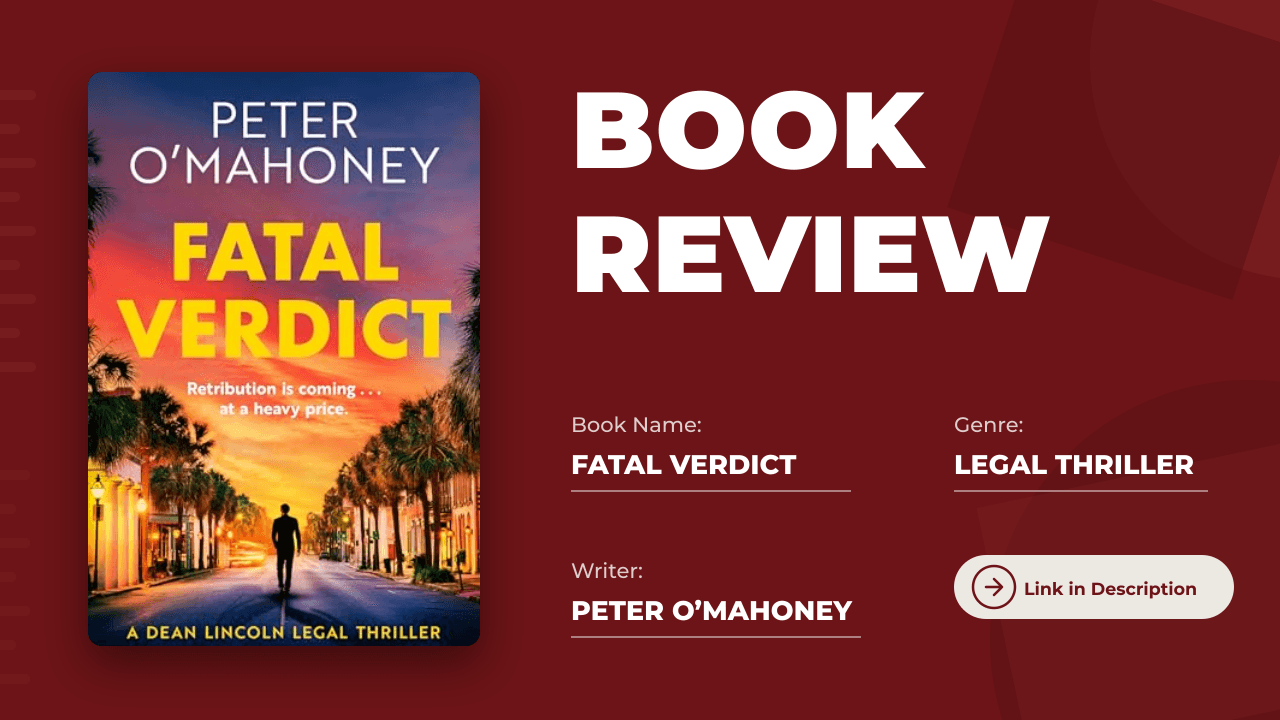
A second book in a legal thriller series has one job above all others: prove the first one wasn't a fluke. Fatal Verdict by Peter O'Mahoney takes that job seriously, sending Dean Lincoln back into the same moss-draped, secret-keeping version of Beaufort, South Carolina, and handing him a case that's even messier than the one that introduced him.
I came to "Fatal Verdict" straight off "Reckoning Hour," O'Mahoney's first Dean Lincoln book, and the sequel does exactly what you'd want a follow-up to do: it keeps the courtroom craft that made the first book work, leans harder into the town's rotten underside, and gives Lincoln a case with more moving parts and more ways to go wrong. It doesn't entirely escape the weaknesses of the original, and in a few places it amplifies them, but as a piece of pure page-turning legal thriller construction, it mostly delivers.
In this review, I'll walk through the case at the center of the book, how Beaufort's particular brand of corruption gets pushed further this time around, where Lincoln's personal stakes stand after the first book, and where the story's reliance on Southern stereotypes becomes a genuine liability rather than just texture. I'll also talk about how "Fatal Verdict" stacks up against "Reckoning Hour," because most readers picking this up will be asking exactly that question.
Overview: What Fatal Verdict Is About

"Fatal Verdict" finds Dean Lincoln defending Haley Finch, a young woman accused of murdering her much older boyfriend not long after he won a substantial lottery jackpot and changed his will in her favor. On paper, the motive writes itself: a windfall, a will, and a beneficiary with every reason to want the ink dry before anyone changed their mind. O'Mahoney complicates the picture immediately by adding Haley's estranged husband to the equation, a man who's been conspicuously missing for two years while the couple's marital funds have been quietly draining away.
That's a lot of motive pointed in a lot of directions, and O'Mahoney uses it well. The prosecution's case against Haley looks clean at first glance, clean enough that Lincoln has to work hard to convince anyone, including at times himself, that there's more going on beneath it. As with the first book, the real story isn't really about whether Haley is guilty, it's about how much Beaufort's money and influence are shaping the answer before the facts get a fair hearing.
Money, Missing Husbands, and a Town That Keeps Score
What I appreciated most about the setup here is that O'Mahoney doesn't let the missing husband become a cheap red herring. His absence, and the dwindling marital funds tied to it, gets treated as a real thread worth pulling, not just a device to make Haley's guilt feel less certain. The novel takes its time letting Lincoln, and the reader, sit with the discomfort of not knowing whether Haley is a wronged woman or a very good liar, and that ambiguity carries the middle third of the book.
The town itself remains as central to the story as it was in "Reckoning Hour." Beaufort's charm is once again shown to be a surface layer over a place where money and influence outweigh justice more often than anyone in it wants to admit. O'Mahoney's central argument across both books is consistent: in a town this small, with this much old money and this much shared history, the truth is rarely the thing that decides a case first.
Dean Lincoln: Same Fire, Higher Stakes
Lincoln himself picks up more or less where "Reckoning Hour" left him, still carrying the scars of the grudges that resurfaced when he came home, and still willing to risk his career and his safety to get a case right rather than just win it. "Fatal Verdict" raises the personal cost of that instinct. The book is explicit that Lincoln will have to risk everything he loves to dig down to the truth this time, and it follows through on that promise more aggressively than the first book did, putting people close to him in genuine danger rather than keeping the threat mostly professional.
This is where the sequel earns some of its strongest material. Lincoln isn't just defending Haley Finch, he's defending his own decision to stay in Beaufort at all, and the accumulating cost of that decision gives "Fatal Verdict" a sense of momentum that a standalone case-of-the-week thriller wouldn't have. Series regulars will notice the throughlines from book one paying off here, and new readers will still get enough context to follow what's at stake for Lincoln personally.
The Courtroom Craft That Made the First Book Work
O'Mahoney's strongest skill, both here and in "Reckoning Hour," is structuring a trial. The courtroom scenes in "Fatal Verdict" are genuinely thrilling, built with the same careful plant-and-payoff rhythm that made the first book's reveals feel earned rather than convenient. Cross-examinations move with real tactical intelligence, and the case against Haley shifts credibly as new information surfaces during testimony rather than being dumped on the reader between chapters.
The pacing outside the courtroom is smooth as well. O'Mahoney isn't writing for readers who want to linger, he's writing for readers who want to keep turning pages, and the prose gets out of its own way to let the plot do the work. If you enjoyed the trial sequences in the first book, this is more of exactly that, arguably sharpened by a second outing's worth of practice.
Where the Formula Strains: Beaufort's Rot, Round Two
Here's where the title of this review earns its qualifier. "Fatal Verdict" doubles down on everything that defined Beaufort in "Reckoning Hour," and while that mostly works, it comes at a cost. The alternate suspects the plot dangles in front of Lincoln (and the reader) lean noticeably into Southern stereotype, characters who feel constructed to fit a type rather than to feel like specific people. Some readers who found the first book's "we do things differently here" repetition tiresome will find this one leaning on similar shorthand, just applied to a wider cast.
There is one genuine improvement worth flagging: readers who found some of the harsher, more stereotyped characterization in "Reckoning Hour" uncomfortable have noted that O'Mahoney reins it in considerably here, trading some of that edge for a cast that's still broadly drawn but less harshly caricatured. That's a real step forward even as the general reliance on Southern-thriller shorthand remains a fair criticism of the book.
How Fatal Verdict Compares to Reckoning Hour
Most readers finishing "Reckoning Hour" will pick this up hoping for more of the same, and that's largely what they get. The case is arguably more tightly plotted this time, with more genuine ambiguity about who actually did it, and Lincoln's personal stakes are higher. Where the sequel falls slightly short of the original is in freshness: the "wealthy suspects and their secrets versus a Beaufort defense attorney with his own history" formula was novel in book one, and it's a known quantity by book two. That's not a fatal flaw so much as the natural cost of being a sequel, and O'Mahoney compensates for it with tighter courtroom mechanics and higher personal stakes for Lincoln.
About Author Peter O'Mahoney
Peter O'Mahoney is a bestselling author of legal thrillers, including the Joe Hennessy, Tex Hunter, and Jack Valentine series, and his background in psychology and criminology continues to show up in how carefully "Fatal Verdict" handles the mechanics of building and dismantling a criminal case. His stated love of Perry Mason as a formative influence is easy to see in how much narrative weight both Dean Lincoln books place on the courtroom as the place where the truth finally gets forced into the open, even when the town around it would rather it stayed buried.
Critical Reception and Reader Response
"Fatal Verdict" has actually outperformed its predecessor in reader ratings, holding a 4.36-star average across more than 8,300 Goodreads ratings, compared to 4.29 stars for "Reckoning Hour." Readers consistently praise the pacing, calling the writing "smooth" and "thrilling in the courtroom scenes," with several noting the book pulled them in from the beginning and never dragged.
The criticism that does surface tracks closely with what I noticed reading it: some readers found the alternate suspects "just a bit too stereotypical" and the overall Southern atmosphere laid on a bit thick in places. A number of reviewers who compared it directly to "Reckoning Hour" felt the first book still edges it out overall, even while acknowledging "Fatal Verdict" is a strong, confident sequel in its own right.
Key Takeaways from Fatal Verdict
The case is genuinely ambiguous. The missing husband and dwindling funds give the plot real uncertainty about Haley Finch's guilt, rather than a foregone conclusion dressed up as a mystery.
Lincoln's stakes are personal now. The book follows through on threatening the people and things Lincoln cares about, not just his professional record.
The courtroom scenes remain the book's strongest asset. O'Mahoney's plant-and-payoff structure for trial reveals is even more confident here than in the first book.
The stereotyping is a real weakness. The alternate suspects lean into Southern-thriller shorthand more than fully realized characterization, even as some of the harsher edges from book one have been smoothed out.
It's a slightly weaker follow-up to a strong opener. "Fatal Verdict" doesn't quite recapture the novelty of "Reckoning Hour," but it compensates with tighter plotting and higher personal stakes.
Conclusion: Is Fatal Verdict Worth Reading?
"Fatal Verdict" is a confident, well-plotted second entry in the Dean Lincoln Legal Thriller series, one that keeps the courtroom tension that made "Reckoning Hour" work while raising the personal cost of Lincoln's commitment to the truth. It leans harder into Beaufort's rot, both the town's corruption and, less successfully, some of its stereotyping, but the trial itself is sharp enough, and Haley Finch's case ambiguous enough, to carry the book through its weaker moments.
If you read "Reckoning Hour" and wanted more of Dean Lincoln fighting Beaufort's money and influence from the inside, "Fatal Verdict" delivers that, mostly on the strength of its courtroom craft rather than any new tricks. You can pick up a copy of "Fatal Verdict" on Amazon and see whether Lincoln gets any closer to a town that keeps finding new ways to make the truth expensive.