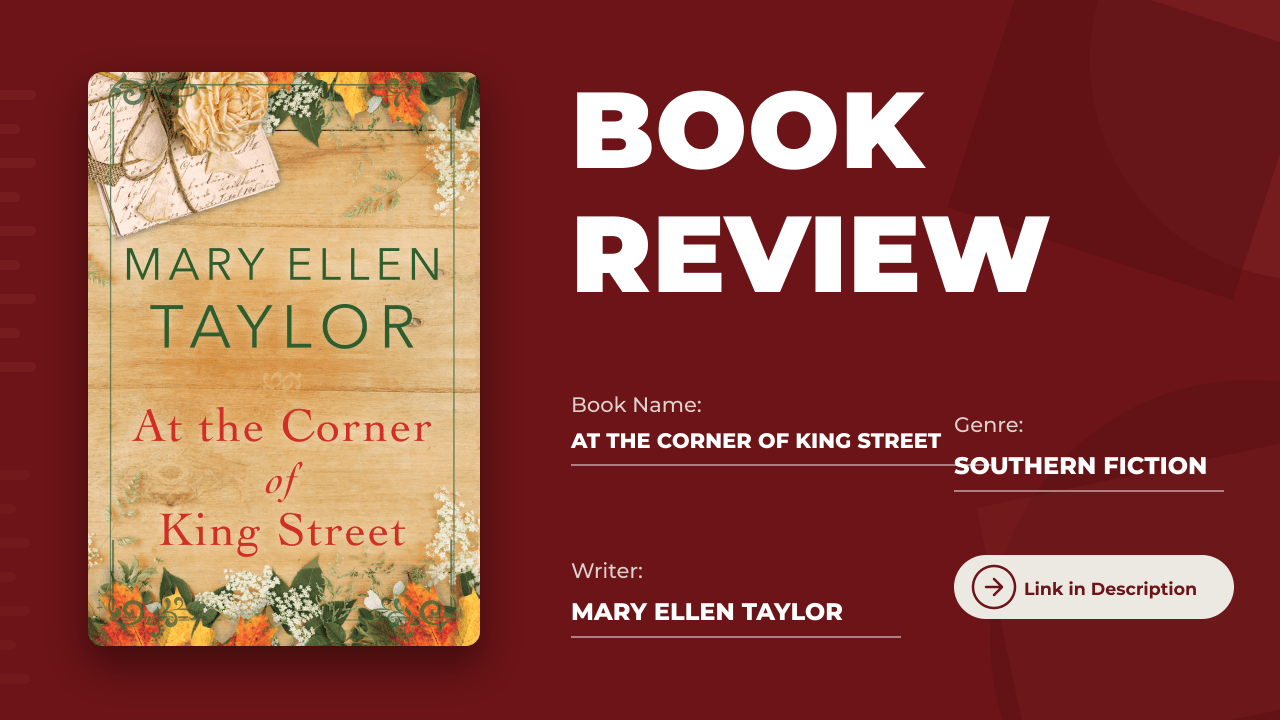
At the Corner of King Street Review: Witch Bottles, Salvage Yards, and a Family History That Won't Stay Buried
- Sajjad
- Book Reviews
- 12 Sep, 2026
Some family secrets stay buried because no one goes looking. Others stay buried because the ground itself seems determined to keep them. At the Corner of King Street by Mary Ellen Taylor is squarely the second kind of story, a novel where a centuries-old bottle sealed with pins, herbs, and someone's old fear turns out to be the least comfortable thing Addie Morgan digs up on her way back to a family she spent years trying to leave behind.
I went into "At the Corner of King Street" expecting a fairly gentle contemporary Southern novel about a woman reconnecting with home. What I got was that, plus a genuinely eerie dual-timeline mystery involving colonial Alexandria, an architectural salvage yard doubling as a metaphor for the family that runs it, and a question the book refuses to answer easily: is this family cursed, or is something far more ordinary, and far harder to fix, running through its women instead.
In this review, I'll cover Addie's return home and the life she's asked to put on hold, the salvage yard and the witch bottle she stumbles across while working in it, the colonial-era thread that runs alongside the present-day story, and the book's central, unresolved question about whether the Morgan family's troubles are supernatural or something more painfully human. I'll also talk about where Taylor's ambitious structure asks a lot of the reader, and where it delivers.
Overview: What At the Corner of King Street Is About

"At the Corner of King Street" introduces Addie Morgan seven years into the life she built for herself after leaving Alexandria, Virginia behind: a job at a country vineyard, a steady relationship with the vineyard's owner, Scott, and a comfortable distance from a childhood defined by conflict and loss. That distance collapses the moment Addie's sister, Janet, gives birth to a baby she isn't in a position to raise. Addie is called home not just to help with a newborn niece, but to step back into a family she'd carefully built a life around avoiding.
Once back in Alexandria, Addie finds herself pulled into two things at once: the day-to-day work of her Aunt Grace's architectural salvage business, and a piece of family history that predates anyone currently living. Buried in the course of the salvage work is a witch bottle, a small, sealed vessel tied to old protective folk magic, and with it, a thread connecting the present-day Morgan women to a colonial-era story the book unspools in parallel chapters. What starts as an inherited business obligation becomes an inheritance of a much stranger kind.
The Salvage Yard as Family Metaphor
Shire Architectural Salvage, the family business Addie is drawn back into, does double duty in this novel as both setting and symbol. Aunt Grace runs the yard on a simple, unsentimental philosophy: no Shire woman gets a free ride. Salvage, by definition, is about finding value and use in things other people have discarded, giving broken or abandoned pieces of houses a second life in someone else's home. Taylor leans into that parallel deliberately, the yard becomes a working metaphor for the Morgan women themselves, people who've been discarded by circumstance, by illness, or by their own family's history, and who are, in one way or another, looking for a second chance at some kind of life.
That metaphor gives the novel's more mundane, present-day plotting, family obligation, financial strain on the business, Addie's uncertain footing between her old family and her new one, real thematic weight rather than letting it feel like filler between the more atmospheric colonial-era chapters.
The Witch Bottle and a History That Predates Everyone Living
The witch bottle itself is the novel's most striking device, both literally and structurally. Discovered amid the salvage yard's inventory, it ties the present-day Morgan family to an eighteenth-century thread that Taylor weaves through alternating chapters, using the historical voice to illuminate exactly what the modern-day mystery is circling around. This is where "At the Corner of King Street" earns comparisons to Taylor's other dual-timeline work: the historical passages aren't decorative texture, they're doing real narrative labor, filling in the origins of whatever it is that's supposedly followed the Morgan women down through the generations.
Modern witch bottles reappear later in the book as well, repurposed by the characters themselves as vessels for hopes and intentions rather than curses, a nice thematic inversion that reframes an object associated with old fear into something closer to healing. It's a smart piece of symbolism that ties the historical and contemporary threads together without over-explaining itself.
Is It a Curse, or Is It Something Harder to Accept?
The question at the emotional center of this novel is whether the trouble that's followed the Morgan women for generations is genuinely supernatural, a family curse in the literal sense the witch bottle implies, or something more grounded and, in some ways, more difficult to sit with: a pattern of mental illness running through the family that's easier to attribute to old folklore than to confront directly. Janet's own psychological instability, the crisis that pulls Addie home in the first place, sits at the heart of that ambiguity, and Taylor is careful not to resolve it too neatly in either direction.
That refusal to pick a clean answer is the book's smartest choice. It would have been easy to write this as a straightforward paranormal family-curse story, or alternatively as a straightforward literary novel about mental illness dressed up with a spooky prop. Instead, Taylor lets both readings sit uneasily next to each other, which mirrors how the characters themselves experience it: never entirely sure whether they're fighting something ancient and external, or something that's simply, painfully, theirs.
Addie and Grace: Two Ways of Carrying Family Obligation
Addie and her Aunt Grace represent two different answers to the question the book keeps circling: how much do you owe the family you were born into. Grace's brisk, unsentimental "no free ride" ethic has kept the salvage business, and by extension the family, functioning for years, but it comes at the cost of warmth. Addie's instinct is closer to escape, the seven years at the vineyard were as much about distance as about Scott, and her return forces her to renegotiate how much of her old life she's willing to let back in.
That tension extends into Addie's romantic life as well. Her relationship with Scott represents the future she'd planned for herself, uncomplicated by her family's history, while her unresolved connection to Zeb, her sister's ex-husband, drags her back toward exactly the entanglements she left Alexandria to avoid. Whether Addie should have told Scott about her family's past before now becomes one of the novel's more grounded, relatable tensions, a question about honesty in a relationship that doesn't need a witch bottle to feel high-stakes.
Where the Book's Ambition Shows Some Strain
I want to be fair about where "At the Corner of King Street" asks more patience than it always rewards. Juggling a contemporary family drama, a newborn-care subplot, a financially strained business, a romantic entanglement, and a colonial-era historical mystery is a lot of plot for one novel to carry, and there are stretches where the present-day family drama, particularly the details of caring for Addie's niece and managing the salvage business's finances, moves at a slower pace than the more atmospheric historical chapters. Readers looking primarily for the witch bottle mystery may find themselves waiting through some fairly conventional domestic drama to get back to it.
The ambiguity around the curse-versus-illness question, while thematically smart, also means the book doesn't offer the tidy supernatural payoff that a more straightforward paranormal read might promise. That's a deliberate choice I respect, but it's worth knowing going in if you're hoping for a clean, spooky resolution rather than a more open-ended meditation on inherited trauma.
Mary Ellen Taylor's Dual-Timeline Craft
Taylor has built much of her career on this kind of dual-timeline structure, and "At the Corner of King Street" shows why the format suits her. The historical Alexandria chapters are grounded in real period detail, and the way she uses the colonial storyline to inform, rather than simply parallel, the present-day mystery is more disciplined than a lot of dual-timeline fiction manages. The prose throughout has a warm, unhurried quality suited to its Southern setting, favoring atmosphere and character interiority over pace, which will read as either comforting or slow depending on what you're looking for.
Critical Reception and Reader Response
"At the Corner of King Street" holds a strong 4.30-star average across nearly 9,800 Goodreads ratings, reflecting a warm reception as the opening book in Taylor's Alexandria series. Readers have specifically praised how the novel balances vivid setting, history, and everyday family drama, with one review going so far as to say the portrayal of mental illness's impact on a family reads less like fiction and more like memoir, a strong compliment for a novel built around a supposedly supernatural premise.
The reception is consistently warm rather than divided, which tracks with what I found reading it: this is a comfort-read version of a dark premise, more interested in emotional truth than in scares, and readers coming to it for cozy Southern family fiction with a historical mystery layered in tend to come away satisfied.
About Author Mary Ellen Taylor and the Alexandria Series
Mary Ellen Taylor has built a career on exactly this kind of dual-timeline Southern fiction, and "At the Corner of King Street" launches her Alexandria series, continuing with "The View from Prince Street" and further entries that keep returning to the same richly rendered Virginia setting. Readers who enjoy this book's blend of contemporary family drama and colonial-era history will find more of the same sensibility waiting in the rest of the series.
Key Takeaways from At the Corner of King Street
The salvage yard is doing real thematic work. Shire Architectural Salvage's business of giving discarded things new purpose mirrors the Morgan women's own search for second chances.
The curse-versus-illness ambiguity is the book's smartest choice. Taylor refuses to resolve whether the family's troubles are supernatural or psychological, and that refusal is more honest than a tidy answer would have been.
The witch bottle symbolism cuts both ways. What begins as an object of old fear gets reclaimed by the present-day characters as a vessel for hope, a smart inversion that ties both timelines together.
The pacing rewards patience over spectacle. This is a slower, atmosphere-driven read, and readers wanting a fast-moving supernatural mystery may find the domestic drama takes up more space than expected.
It's the start of a series worth continuing. As the opener to the Alexandria series, the book sets up a setting and sensibility Taylor clearly has more to say about.
Conclusion: Is At the Corner of King Street Worth Reading?
"At the Corner of King Street" is a warm, atmospheric dual-timeline novel that uses a genuinely eerie premise, a witch bottle, a family curse, a colonial-era mystery, to tell a grounded story about what families pass down to each other, whether that's superstition, illness, or simply the weight of history no one's ever fully examined. Addie's return to Alexandria, and the uncomfortable choice between the life she built and the family she left, gives the novel real emotional stakes beneath its more atmospheric trappings.
If you're looking for Southern family fiction that isn't afraid to sit with an uncomfortable question rather than answer it too neatly, and you don't mind a slower-burn pace to get there, "At the Corner of King Street" delivers. You can pick up a copy of "At the Corner of King Street" on Amazon and decide for yourself whether the Morgan family is cursed, or just carrying something harder to name.